Living giraffes and okapis preserve only a small part of their family’s anatomical history. Fossil relatives included animals with heavy bodies, shorter limbs and elaborate sets of head appendages. Understanding how those forms were related is difficult when the evidence consists of an isolated tooth here or a broken limb bone elsewhere.
At Batallones-10 in Spain, researchers had a much richer opportunity. The site yielded skulls, teeth and bones representing almost the entire skeleton of a large giraffid. María Ríos, Israel M. Sánchez and Jorge Morales used the collection to describe Decennatherium rex in a 2017 PLOS ONE study and reassess its place in the family.
A skull could be connected to a body plan
The deposits date to around nine million years ago, in the early part of the Late Miocene. Among the discoveries was an articulated individual, with bones still associated in a way that helped establish which parts belonged together.
That completeness mattered because giraffid family trees had often relied heavily on limited head material. Many teeth and skeletal features change relatively little between related forms, while some of the most informative differences occur in ossicones and the long bones below the wrist and ankle.
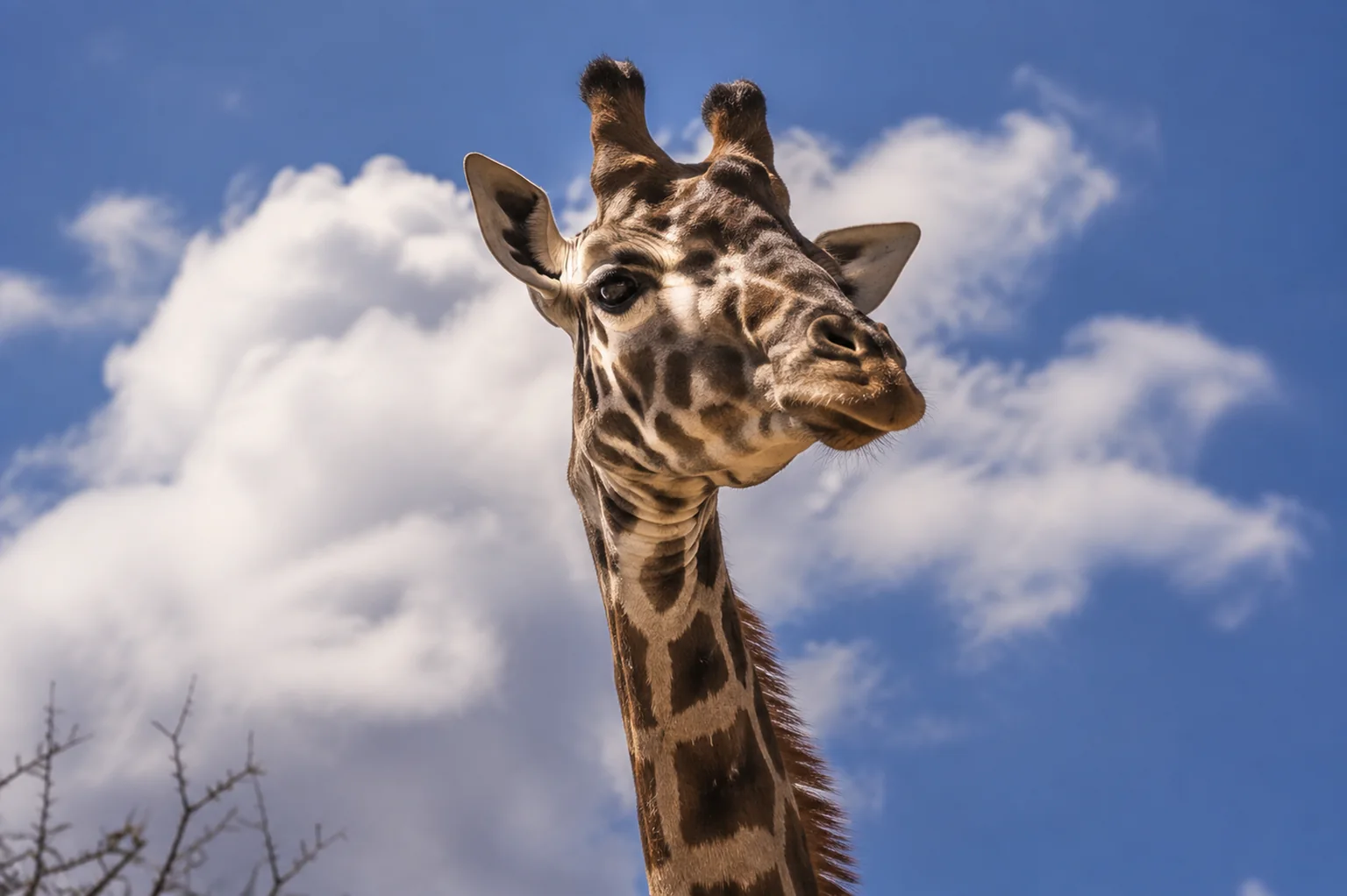
Ossicones are the permanent head appendages familiar from living giraffes, but the fossil forms could be strikingly different. Decennatherium rex had a small front pair above the eyes, directed forwards, and a much larger rear pair that curved backwards. Longitudinal ridges ornamented the rear pair.
Its neck vertebrae were of intermediate length, and its limbs had a robust construction without the most extreme proportions of later giant sivatheres. The collection therefore combined a recognisable headgear pattern with a body that retained a different balance of features.
Shared architecture was more useful than simply counting horns
Four ossicones alone were not enough to establish a close relationship. Other fossil giraffids also had four, but their position, orientation, curvature and relative sizes differed.
The distinctive combination in Decennatherium resembled the arrangement later developed more extremely in Sivatherium: smaller front appendages and larger, backward-curving rear ones. The researchers treated those shared details as evidence to be assessed alongside the teeth and skeleton.
They compiled 111 anatomical characters across 31 taxa and searched for the family tree requiring the fewest changes among those characters. This approach, called maximum parsimony, turns a general resemblance into an explicit hypothesis that can be compared with alternatives.
The resulting tree placed Decennatherium near the base of a group containing samotheres and sivatheres. It linked the Spanish fossils with a broader history of giraffids across Africa and Eurasia, rather than treating their unusual headgear as a local curiosity.
The analysis also expanded the geographical and temporal range assigned to that branch: its early history now included western Europe near the beginning of the Late Miocene. That is a change in the documented fossil record, not proof that the branch first originated at the Spanish site.
The branch was a working hypothesis
The new fossils greatly improved the available character information, but many branches of the reconstructed tree had low support. The authors explicitly treated some relationships as working hypotheses that could change with new fossils, characters or comparisons.
That limitation is especially relevant to the position of the okapi, which differed among analyses. A single best tree does not mean every branch is equally secure. Some groupings can be strongly informed by distinctive anatomy while others remain sensitive to the evidence included.
The broader picture nonetheless became more informative. The fossil family contained several combinations of headgear, neck length and limb robustness. Living giraffes and okapis are survivors of that branching diversity, as our comparison of the two living genera explains.
Two kinds of adult skull
The collection also allowed an unusual within-species comparison. Six skull roofs with ossicones fell into two broad forms: one with less developed headgear and another with larger, more robust appendages.
Differences in tooth wear did not track those forms. Because similarly worn adult teeth accompanied both, the researchers argued that ordinary ageing was unlikely to explain the entire difference. They suggested that the forms might represent females and males, with the larger headgear in males.
Sex could not be directly read from these skulls. The value of the comparison was that it supplied evidence for evaluating a hypothesis that an isolated ossicone could not resolve. The fossils preserved variation within the animal as well as differences between species.
Reconstructing a family with several successful shapes
A separate skeletal reconstruction of Sivatherium giganteum by Christopher Basu and colleagues illustrates the larger anatomical theme. It used three-dimensional skeletal volume to estimate the mass of a robust extinct giraffid, rather than assuming that a spectacular skull implied an elephant-sized body. Both investigations show why headgear must be understood together with the skeleton supporting it.
For Decennatherium, further fossil discoveries could test the proposed branching relationships and the suggested differences between sexes. Additional evidence from tooth wear and chemistry could also refine its diet; the 2017 paper’s anatomical interpretations did not directly establish everything the animal ate.
The collection’s central contribution is already clear. By joining skulls, limbs and neck bones in one richly documented animal, Ríos and colleagues connected features that fragmentary fossils had kept apart. The resulting evolutionary story contains multiple body plans, rather than a single procession towards the proportions of a modern giraffe.
Sources
María Ríos, Israel M. Sánchez, Jorge Morales (2017). A new giraffid (Mammalia, Ruminantia, Pecora) from the late Miocene of Spain, and the evolution of the sivathere-samothere lineage. PLoS ONE. DOI: 10.1371/journal.pone.0185378. Read the full paper.