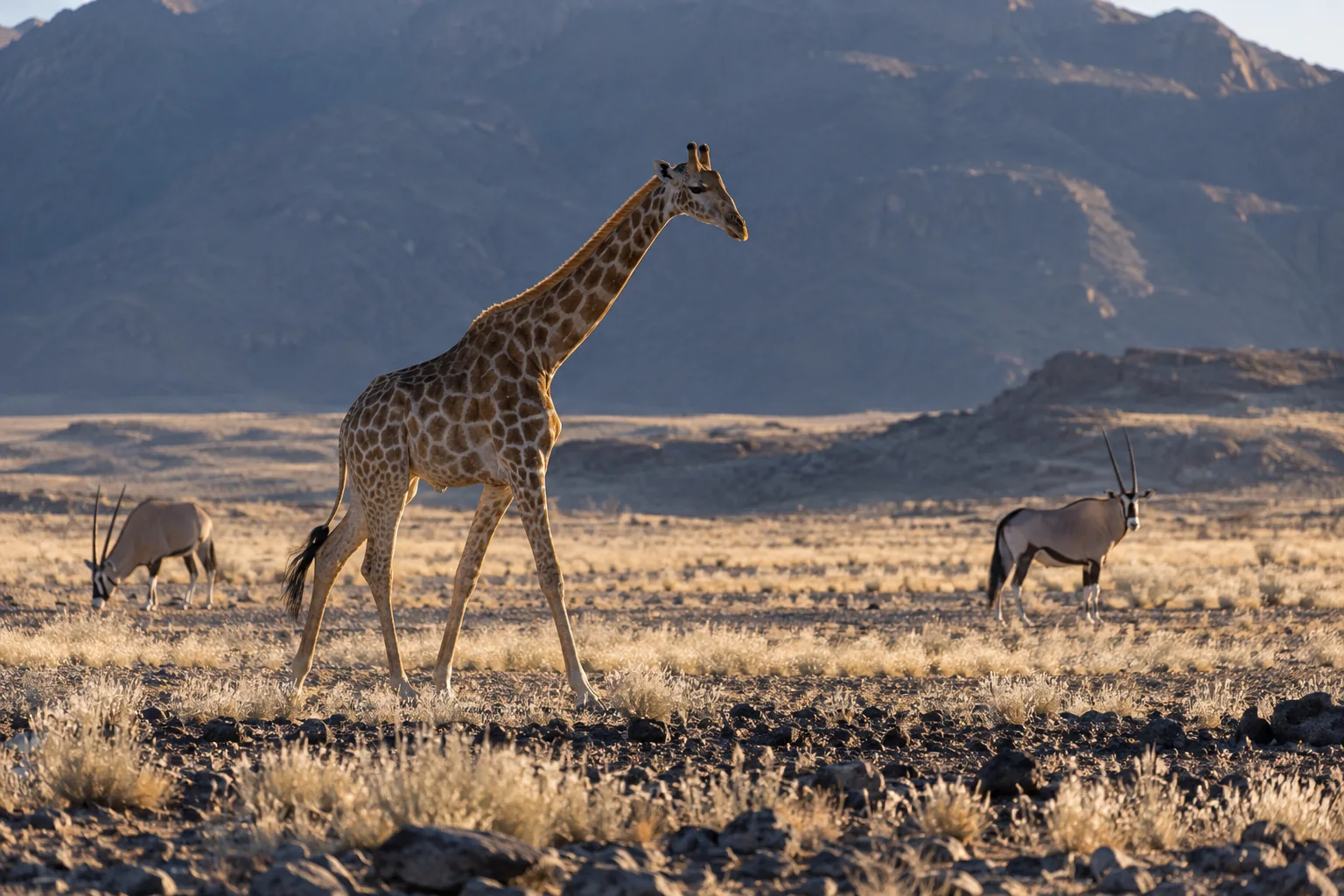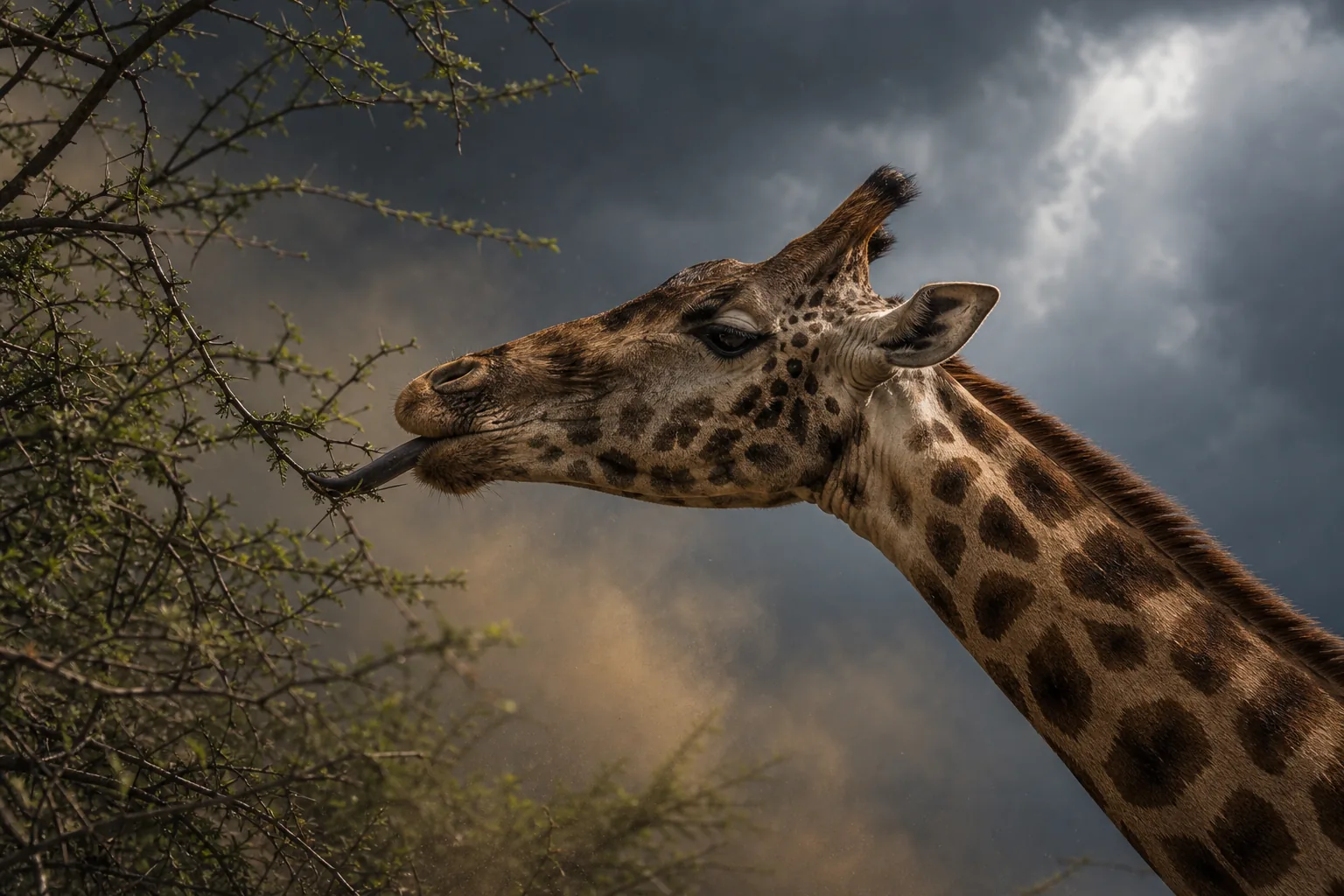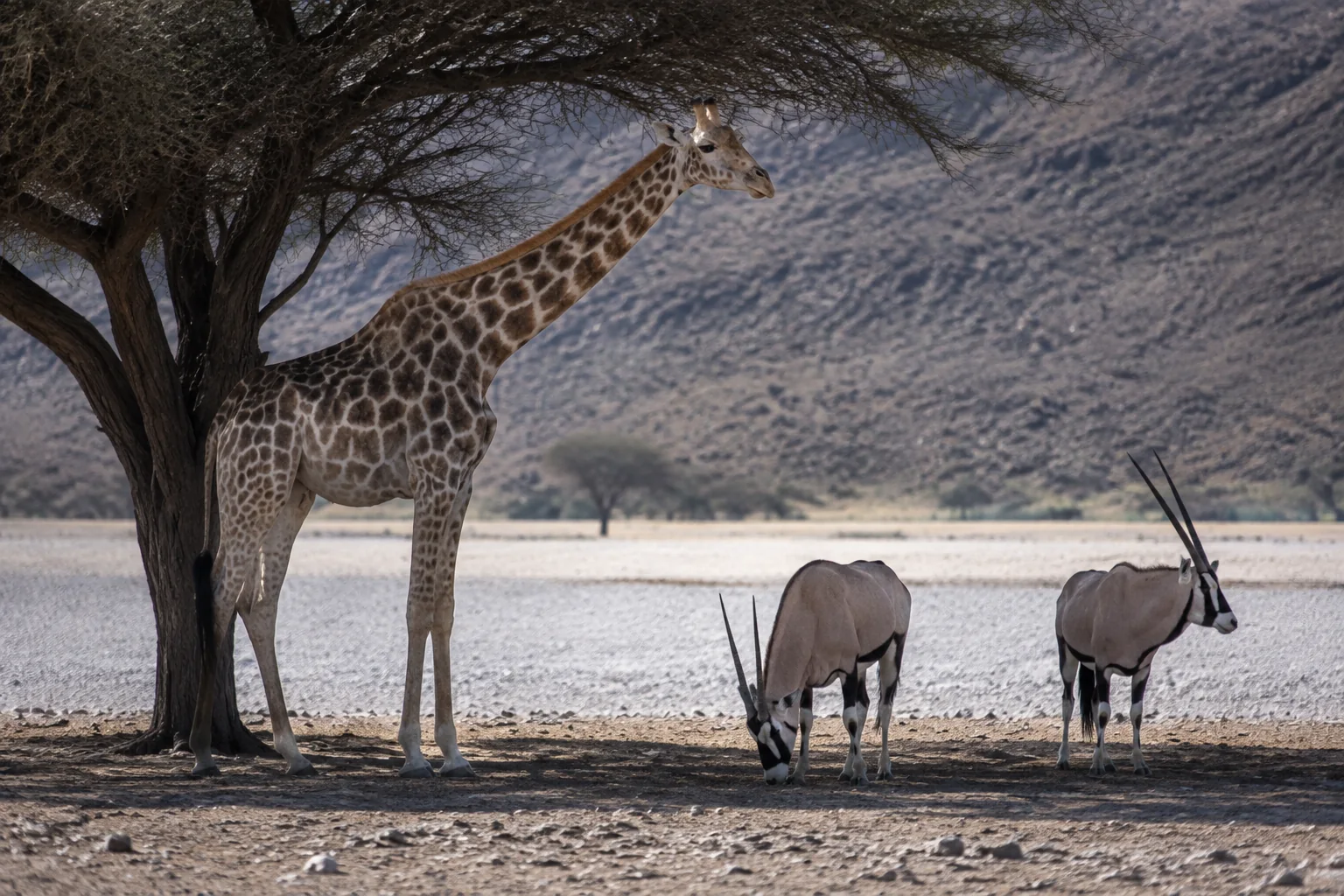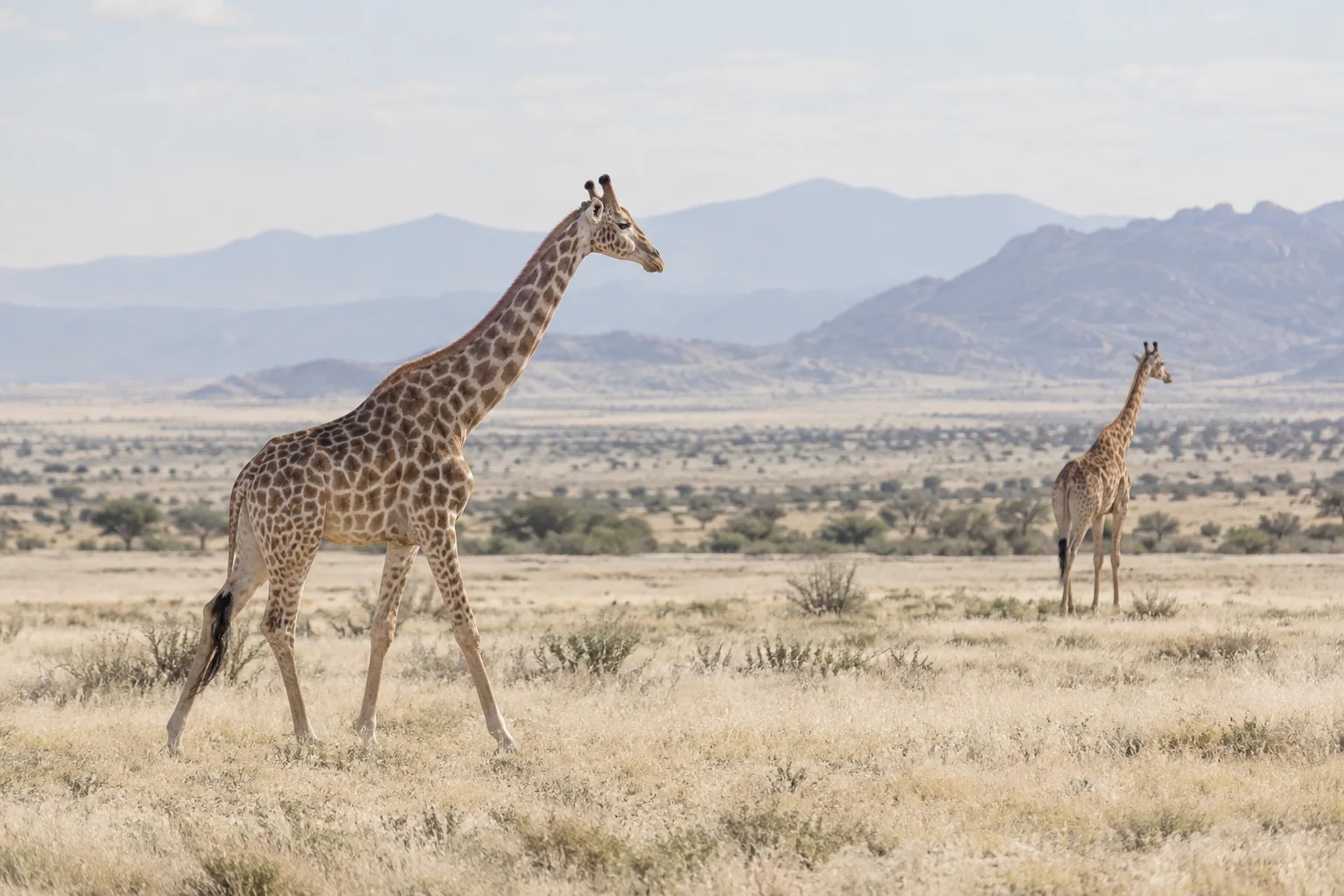
For an introduced giraffe, a landscape rich in food during one season may become a different place when winter arrives. At Sanbona Wildlife Reserve in South Africa's Little Karoo, sweet thorn supplied much of the observed feeding. In winter, another tree took the leading place.
A 2016 study by Claire N. Gordon and colleagues found that Schotia afra, the karoo boer-bean, was the most frequently browsed of the focal species during winter. Historical sighting records also suggested that giraffes used a wider spread of vegetation at that time of year.
The result highlighted a basic question for introductions: does the receiving landscape offer suitable food through its seasonal bottleneck? The presence of a familiar food tree during a favourable visit cannot answer that on its own.
Giraffes outside their historical range
The researchers described Sanbona's giraffes as extralimital: animals introduced beyond their natural distribution in the Western Cape and Succulent Karoo.
That context is central to the study. A giraffe can be native to a country without being native to every ecosystem within it. Introducing a conspicuous animal for tourism creates questions about both its own requirements and its effects on the vegetation already there.
Sanbona began introducing giraffes in 2005, with another group arriving in 2008. By the 2014 count, the reserve reported 28 animals. That number supplied context for the fieldwork; it was not a demographic analysis proving the population's long-term viability.
The landscape contained dense sweet-thorn stands along a main drainage system and mixed woody vegetation along smaller tributaries. Those contrasting plant communities offered a way to investigate whether food use and distribution varied with season.
The researchers asked which plants the giraffes ate, which were most frequently browsed, and whether feeding and sightings showed seasonal differences.
Two datasets, two different windows
The dietary observations were made from January to October 2014. Observers watched the first giraffe group encountered on a sampling day, excluding lone males, and recorded the plant species each animal was eating at two-minute intervals during two-hour sessions.
Uncertain plant identifications were checked afterwards on foot. This allowed the researchers to build a direct account of feeding across the sampled seasons without approaching the animals repeatedly during the observation period.
The distribution evidence came from a different source and earlier years. Reserve field guides had recorded giraffe sightings during game drives. The study mapped those records from 2009 through 2013.
This pairing is useful but limited. The maps show where giraffes had been reported in different seasons; the feeding data show which plants observed groups used in 2014. They do not follow the same identified animal from a particular food tree to its next seasonal destination.
Guide sightings can also reflect where vehicles travel, what guides search for and how easily animals are seen. The paper's maps describe recorded distribution, rather than a movement experiment or a detection-corrected estimate of habitat use.
Sweet thorn led overall, but winter differed
The feeding observations identified 17 plant species in the diet. The statistical comparison focused on the five most frequently browsed species.
Sweet thorn, reported in the paper as Acacia karroo, was browsed most overall. It also clearly led the comparison in autumn and spring. Summer did not produce a single clearly dominant species among the leading plants.
Winter was different. Schotia afra became the most frequently browsed focal species, overtaking sweet thorn. The paper's seasonal plots make the switch visible: the distribution of feeding records moves from a strong sweet-thorn emphasis in autumn and spring to a stronger boer-bean emphasis in winter.
These are frequencies of observed feeding, not weighed food intake. Repeated observations can record animals remaining at the same plant, and different plants may supply different amounts per bite.
“Preference” therefore needs to be read in the context of the methods. The study did not present equal amounts of every plant to each giraffe or fully adjust feeding frequency for seasonal availability. The result establishes a seasonal change in recorded use more securely than an intrinsic preference under equal choice.
The distribution records fit a food-based explanation
The historical maps showed a stronger concentration around the main sweet-thorn vegetation during summer, with more winter sightings in the smaller tributaries containing mixed woody species.
That pattern was consistent with the later feeding observations. If sweet thorn loses foliage after winter frosts while other trees retain usable browse, a shift toward those alternatives could help explain why giraffes were recorded more widely.
The authors proposed frost-related leaf loss as an important part of that mechanism. The study did not experimentally manipulate frost or measure a complete chain from leaf loss through individual movement to nutritional benefit.
The safest interpretation is therefore a coherent association: winter feeding shifted, and historical winter sightings extended more into areas with alternative browse. It is evidence worth testing further, rather than proof that each movement was caused by one tree species losing its leaves.
The title of the focal paper uses “dispersal,” but the observations do not establish permanent departure or migration between discrete seasonal ranges. A seasonal change in where animals were seen is the more direct description.
Alternative food does not automatically mean adequate food
Giraffes finding and eating another plant may help them cope with changing conditions. It does not demonstrate that the substitute provides sufficient nutrients, accessible biomass or long-term feeding capacity.
The researchers did not measure a full nutritional budget, survival consequences of winter diet or the cumulative effects of browsing on tree regeneration. Their observations raised those questions.
They also recorded occasional feeding on plants below typical giraffe browsing height. Such behaviour can expand the available menu, but the study did not establish whether it reflected shortage or ordinary flexibility. Similarly, occasional observations of bone chewing were not quantified and cannot diagnose a nutritional deficiency.
For management, these distinctions matter. A change in food use is a signal to investigate, rather than a reason to assume either that the animals are thriving or that they are malnourished.
Assessing both the animals and the habitat
The authors recommended assessing alternative winter browse before introducing giraffes into similar landscapes. They warned that a property dominated by sweet thorn with few alternatives might require supplementary feeding when leaves were lost.
That warning was a management inference, not a tested feeding prescription. This study did not establish the amount or composition of supplementary food required, or compare the ecological consequences of feeding against other management options.
Its wider contribution is to make habitat suitability seasonal. A useful assessment asks when food becomes scarce, which plants remain usable, whether giraffes can reach them and whether repeated use damages those plants.
A later study in a fenced Kalahari reserve described a related pattern with different plants: an evergreen became more important as deciduous browse declined. The plant names differed, but the need to examine seasonal complements was similar.
At Sanbona, the winter switch showed that introducing giraffes also introduces an ongoing ecological relationship. The animals need food throughout the year, and the vegetation must sustain the resulting use. Observing a seasonal diet is an important beginning to understanding that relationship.
Sources
Claire N. Gordon, Liesl Eichenberger, Paul Vorster, Alison J. Leslie and Shayne M. Jacobs (2016). “Diet and seasonal dispersal of extralimital giraffe at Sanbona Wildlife Reserve, Little Karoo, South Africa.” Koedoe 58:a1346. Full paper.
Francois Deacon, Gert Nicolaas Smit and Andri Grobbelaar (2023). “Resources and Habitat Requirements for Giraffes' (Giraffa camelopardalis) Diet Selection in the Northwestern Kalahari, South Africa.” Animals 13:2188. Related seasonal feeding study.