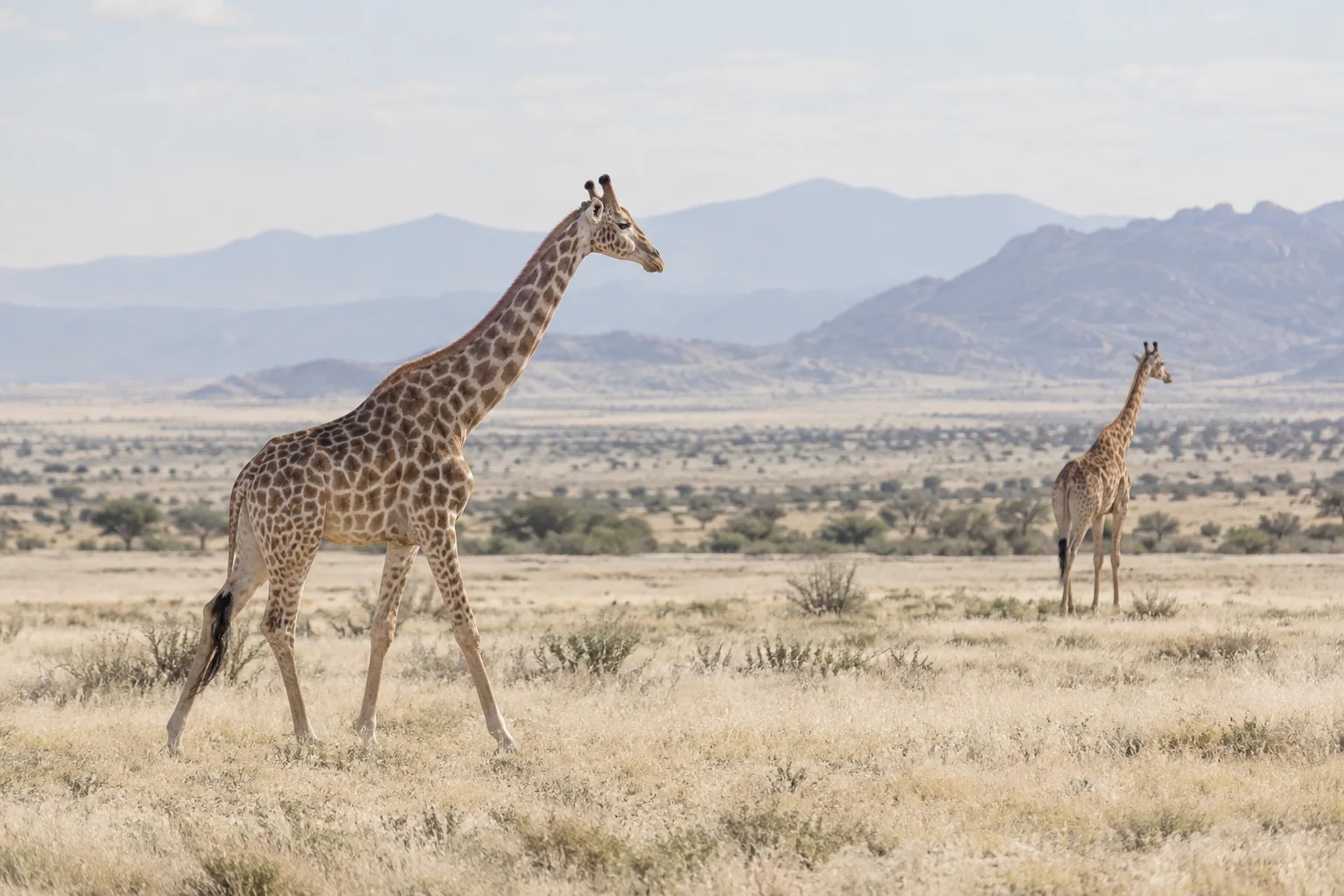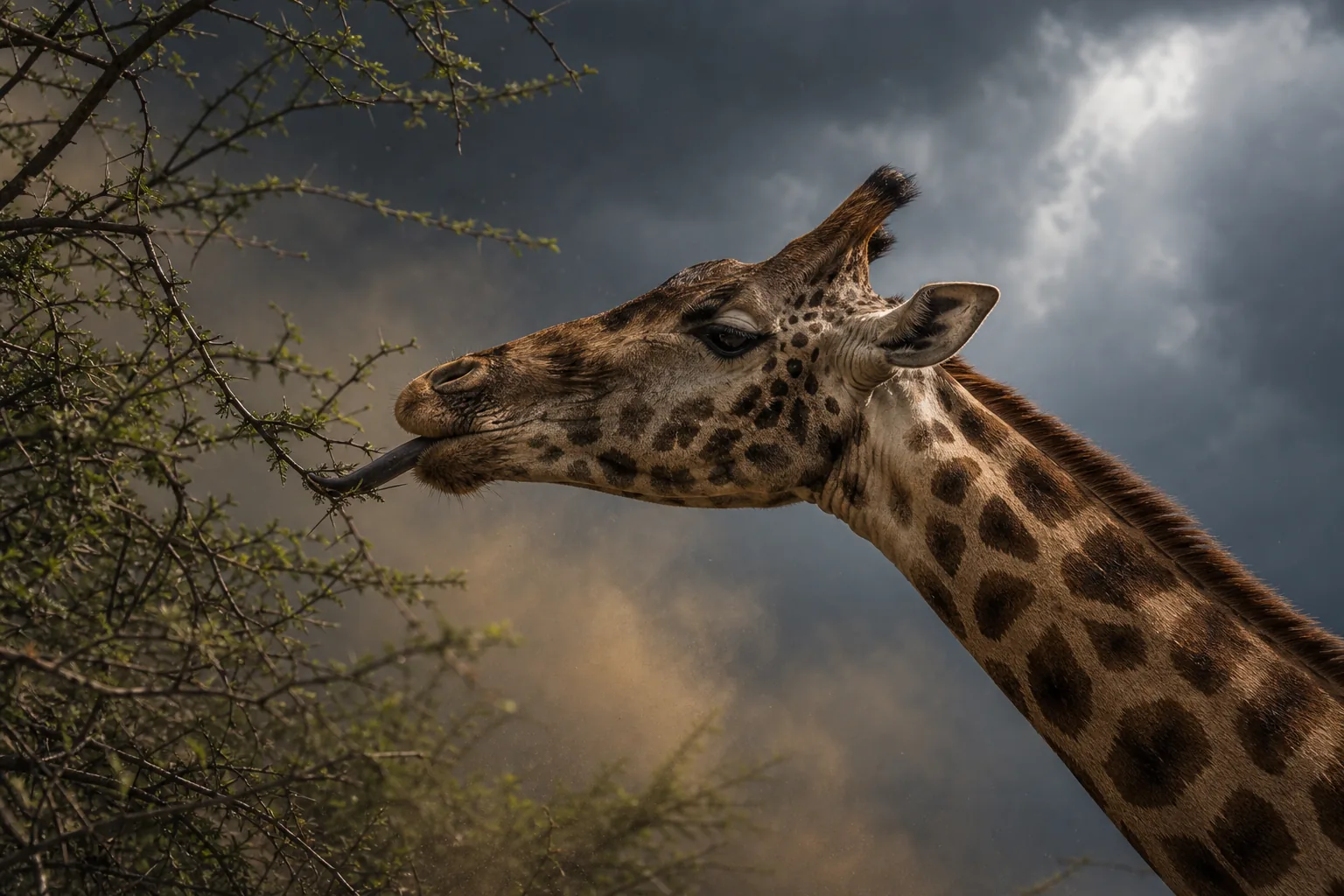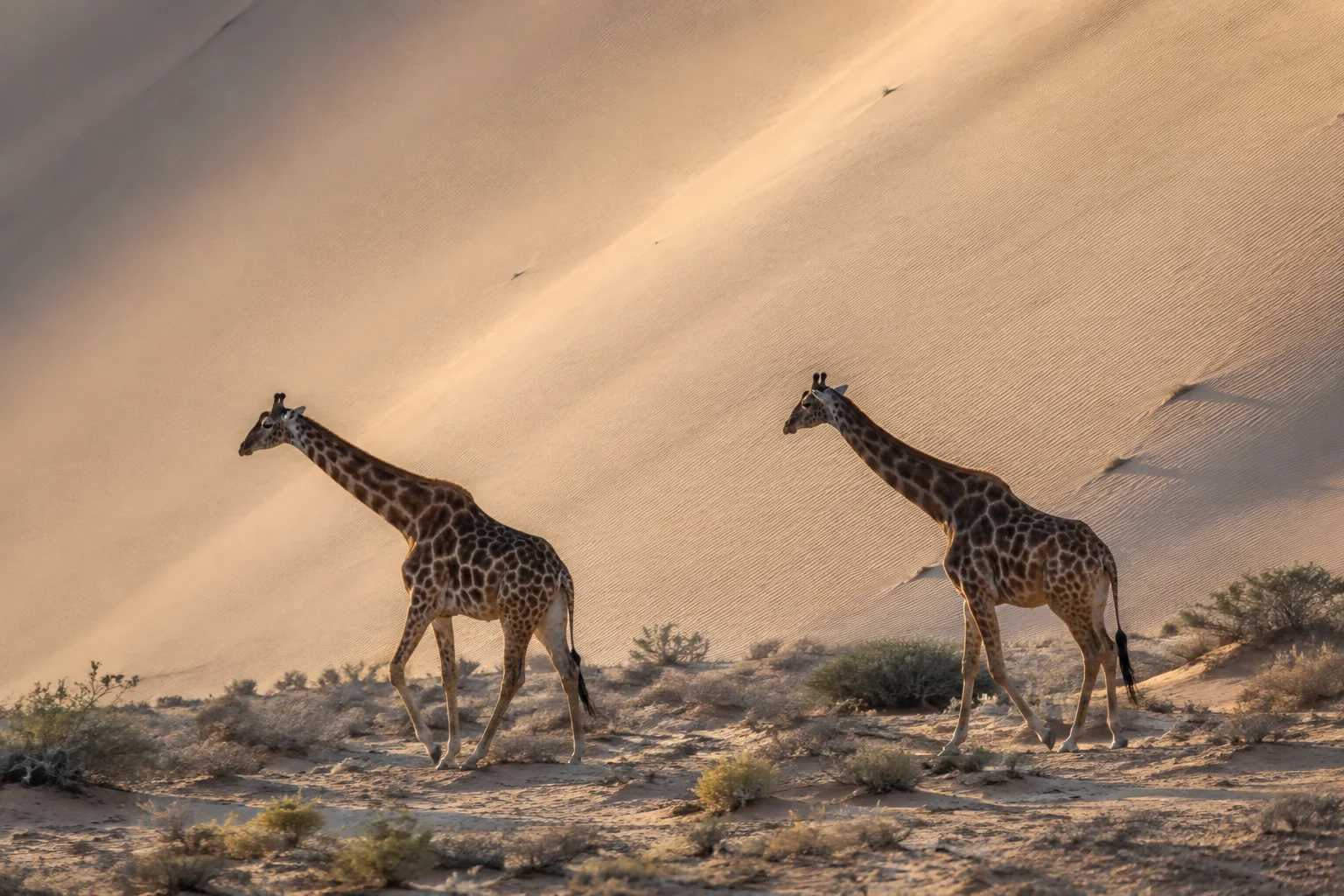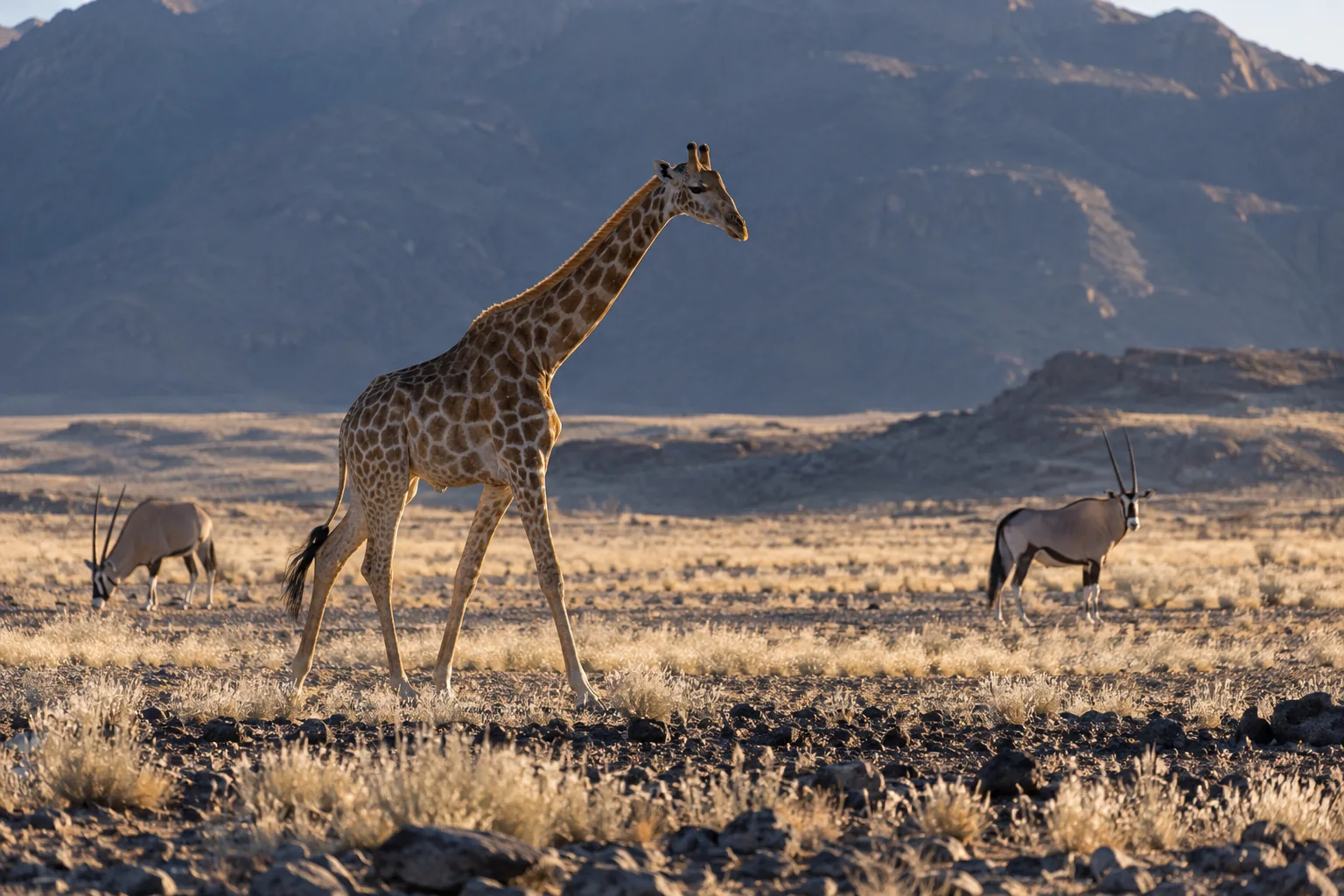
A reserve can contain plenty of woody plants and still offer a giraffe a surprisingly narrow menu. In South Africa's northwestern Kalahari, researchers recorded giraffes feeding on 18 woody species. Four of them accounted for about 93% of the feeding observations.
The less obvious finding concerned the calendar. As deciduous trees lost leaves, an evergreen that contributed relatively little to the annual total became more important. Habitat value depended on which plants provided food during the lean part of the year, rather than simply how many plants were present.
Francois Deacon, Gert Nicolaas Smit and Andri Grobbelaar documented that pattern in their 2023 study of Khamab Kalahari Nature Reserve. The work provides a local lesson for evaluating giraffe habitat: count usable food through the seasons, including the months when a green-season inspection would be misleading.
Following feeding through an entire annual cycle
The reserve's giraffes had been introduced into a fenced landscape. The study therefore concerned animals living within a particular managed boundary, rather than giraffes free to follow resources across the wider Kalahari.
For 15 months, from June 2012 to August 2013, the researchers observed giraffes for ten consecutive days each month. They used the position of a GPS-collared female to help locate groups, which ranged from two to 26 animals during observations.
The collar was a way to find giraffes, not the entire dietary sample. Once a group was located, observers recorded the visible animals' activities every five minutes from sunrise to sunset and identified the plant being eaten. Periods when animals could not be observed were excluded.
This produced 18,999 feeding observations. A feeding record meant an individual was using a particular plant; two giraffes feeding on the same plant produced two records.
Repeated scans reveal how feeding is distributed among plants over time. They do not measure the kilograms eaten. A bite from one species may differ from a bite from another, and consecutive observations may capture the same prolonged feeding bout. The large record count therefore should not be mistaken for thousands of independent animals or laboratory measurements of intake.
Four trees dominated the observations
The central plants were Vachellia erioloba, Senegalia mellifera, Ziziphus mucronata and Boscia albitrunca. Respectively, they accounted for approximately 45%, 20%, 21% and 7% of the feeding records.
The researchers also assessed the reserve's vegetation. Together, those four species represented about 36% of woody plants per hectare. Their much larger share of feeding records showed that plant use was not simply proportional to how many stems of each species grew there.
The reverse example was striking. Grewia flava represented about 40.5% of woody plants per hectare but only about 2% of feeding observations. An assessment based on stem numbers alone would have placed far more weight on that species than the observed giraffe diet justified.
Tree size and accessible foliage also matter. The authors used an additional measure of vegetation contribution based on tree equivalents, which increased the four central species' combined share relative to their stem-count share. That reinforces the distinction: one plant is not a standard unit of giraffe food.
The study did not analyse leaf chemistry. It could document which plants the giraffes used, but it could not establish a nutrient-based explanation for every choice.
An annual average hides the difficult months
The four trees did not provide an identical service throughout the year. Their leaf retention and renewed growth differed, and the giraffes' feeding records changed with those differences.
Vachellia erioloba remained central to the diet overall. Ziziphus mucronata declined sharply in the spring feeding records when its leaves were unavailable. Senegalia mellifera was less used during winter and could provide renewed growth earlier than some other deciduous trees.
Boscia albitrunca stood apart as an evergreen. It was used more during winter and spring, when deciduous browse was reduced. Its annual contribution of about 7% therefore understates its importance during particular months.
Figure 1 of the paper displays this month-by-month change. The coloured shares expand and contract as the plants' roles shift. Figure 3 puts those changes beside leaf availability, helping explain why a plant can move up the seasonal food ranking even if it remains a modest part of the annual diet.
The authors identified July through October as a critical period of reduced browse availability. The practical issue was a seasonal bottleneck: animals needed to get through the period of scarcity, not merely encounter enough foliage when trees were at their fullest.
Use is not the same as preference under equal choice
The paper often uses the language of selection or preference. In an observational field study, those terms need context.
If giraffes stop feeding on a tree when it loses its leaves, the change may reflect a reduced opportunity to eat it. It does not necessarily mean that the animal's preferred taste has changed. Likewise, greater use of an evergreen may reflect its continued availability while alternatives disappear.
The design did not offer equal quantities of every plant to every giraffe. Animals encountered a real landscape in which species differed in abundance, height, leaf condition and location. Their recorded diet emerged from all those differences together.
Using a collared female to find groups also concentrated observations on animals near that individual. The study did not demonstrate that every giraffe in the reserve, let alone every giraffe in the Kalahari, had the same diet.
Those limits leave the seasonal pattern useful. They simply keep it local and observational.
Why a food shortage cannot be diagnosed from diet alone
The authors reported concern about browsing pressure and a decline in the reserve's giraffe count. They considered food limitation among the possible explanations, alongside predation and difficulties adapting to the introduced environment.
The study did not determine the causes of the deaths. It would therefore go beyond the evidence to say that the observed diet proved the giraffes had starved or that a particular shortage caused the population decline.
Its conclusions also discuss browsing capacity and overstocking. A stocking decision requires more than the feeding percentages presented here: it needs accessible biomass, seasonal renewal, other browsers' consumption, animal condition and acceptable effects on the vegetation.
The dependable management lesson is the need to measure those factors during the limiting season. The article's feeding observations identify which plants warrant particular attention when making that assessment.
A local menu, a wider principle
A study of introduced giraffes at Sanbona in the Little Karoo found a different set of important plants, but a related seasonal issue. Sweet thorn dominated much of the feeding record, while Schotia afra became the most frequently browsed focal species in winter.
The exact plant list therefore does not transfer automatically between reserves. What transfers is the need to examine complementary seasonal resources. A habitat can work because different plants provide usable food at different times.
For the Kalahari population, the four central trees supplied most observed feeding, while the evergreen helped fill a seasonally important role. Protecting giraffe habitat requires noticing both kinds of contribution: the plants that feed animals most of the year and those that remain useful when the usual menu narrows.
Sources
Francois Deacon, Gert Nicolaas Smit and Andri Grobbelaar (2023). “Resources and Habitat Requirements for Giraffes' (Giraffa camelopardalis) Diet Selection in the Northwestern Kalahari, South Africa.” Animals 13:2188. Full paper.
Claire N. Gordon, Liesl Eichenberger, Paul Vorster, Alison J. Leslie and Shayne M. Jacobs (2016). “Diet and seasonal dispersal of extralimital giraffe at Sanbona Wildlife Reserve, Little Karoo, South Africa.” Koedoe 58:a1346. Related seasonal feeding study.