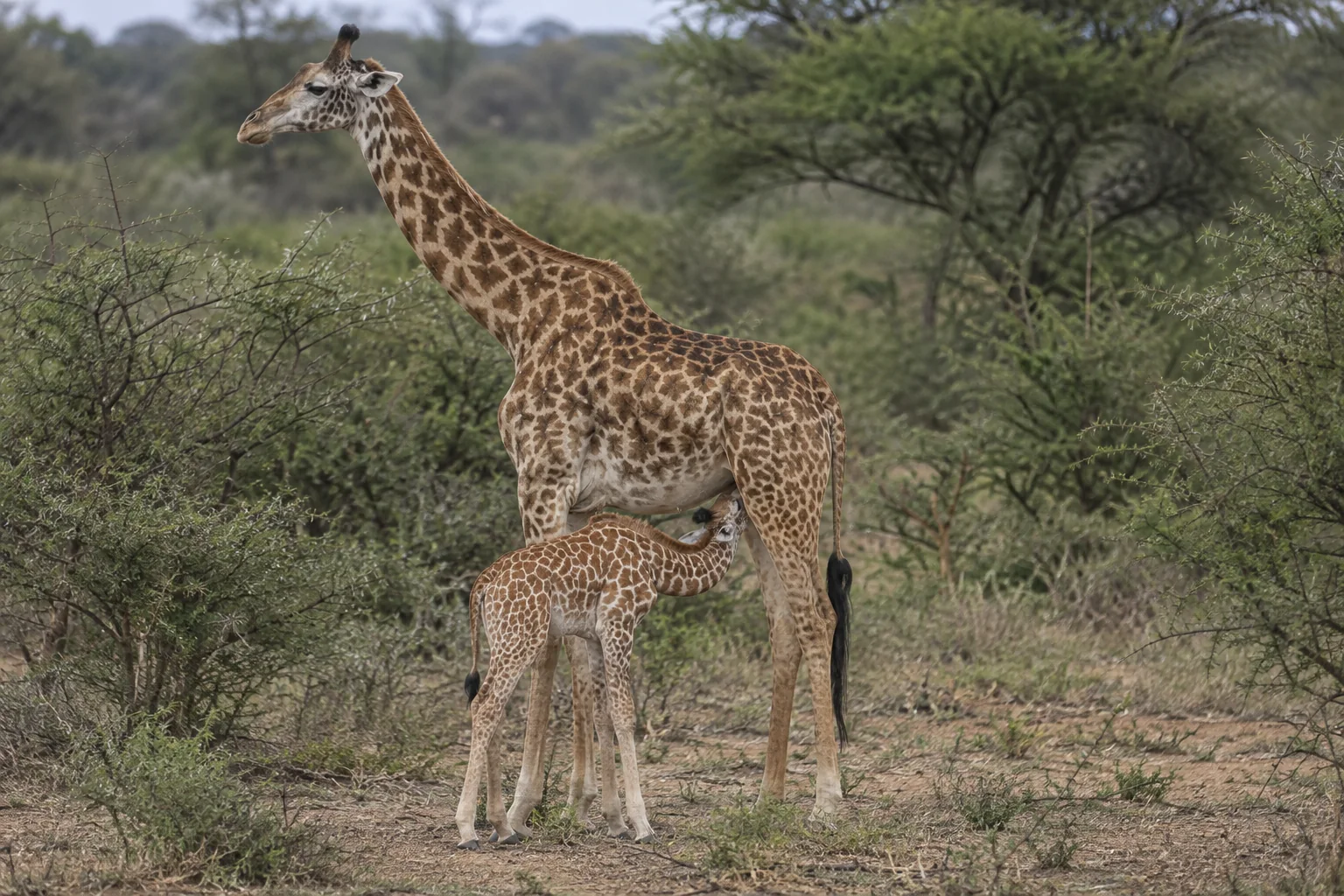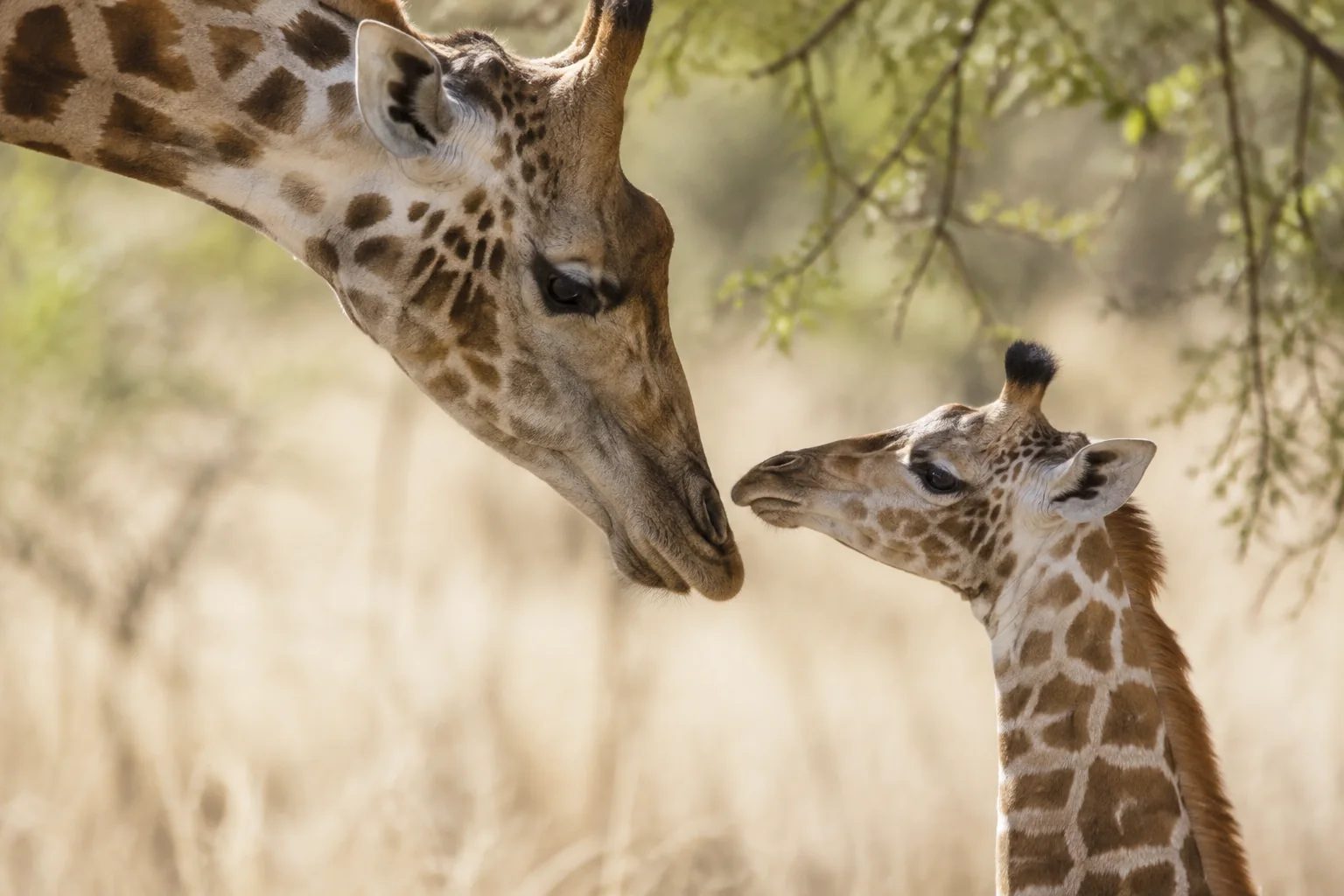
A calf’s death does not necessarily bring a giraffe mother’s attention to an immediate end. In two East African observations, mothers stayed near the remains or the place where their calf had died across several days. Other giraffes sometimes gathered and investigated too.
Megan K. L. Strauss and Zoe Muller reported these events in a short field paper. Its strength lies in the sequence of observations: who remained, who approached, what they touched or sniffed, and how those actions changed as predators and scavengers moved through the site.
The records invite questions about attachment and recognition. They do not reveal the mothers’ subjective experience or establish whether giraffes understand death. Describing the response carefully is the necessary starting point for asking those larger questions.
Two events, two kinds of access
Strauss observed a one-year-old female calf killed by lions in Serengeti National Park, Tanzania, in August 2009. The calf could be identified from its coat pattern. Its mother and two other adult females remained within a few hundred metres while lions fed.
The next day, after the lions moved away, hyenas consumed the remaining material. The mother approached the area where the calf had died, lowered her head repeatedly and appeared to sniff the ground. On the third day she was still nearby, standing alert. On the fourth she was seen several kilometres away with other giraffes.
This was not continuous observation of every hour. The sequence establishes repeated presence across days and records particular actions when the animals were visible. It cannot tell us every place the mother visited or everything she did between sightings.
Muller’s observation began in May 2010 at Soysambu Conservancy in Kenya. A four-week-old calf with a severe leg deformity was found dead after having been seen alive earlier that morning. The authors suspected a natural cause; the death was not observed directly.
The mother and other females gathered close to the body. Some nudged it with their muzzles, and both adults and juveniles sniffed it. By the afternoon, the reported gathering included 23 females and four juveniles. Numbers declined over the following day, but the mother remained.
On the third morning, after scavengers had partly consumed and moved the body, she stood over the remains. By the fourth day the carcass had been completely consumed, yet she stayed at the site until that afternoon. No giraffes were observed there during the following six days.
Staying near a body is not a single behaviour
The contrast between the sites matters. Lions and hyenas at the Serengeti carcass restricted opportunities to approach. At Soysambu, females and juveniles could investigate the body closely for longer.
A mother watching from a distance and a mother touching a calf therefore cannot be compared without considering access. The distance may partly reflect immediate danger, rather than a weaker attachment or less interest.
The records also separated the mother’s response from the presence of other animals. Other females and juveniles showed substantial interest at Soysambu, but their relationships to the calf were unknown. Adult males approached the broader gathering there without closely investigating the remains; their observed attention was directed toward females.
That does not establish a universal sex difference in responses to death. It describes who did what during two unusual events. The presence of many animals around a carcass should not be converted into a claim that every participant was responding for the same reason.
Recognition may persist after responsiveness ends
The authors proposed a possible connection with ordinary maternal behaviour. Young giraffe calves can spend time apart from their mothers, who later return to find them. A persistent tendency to search and check could be valuable when a living calf is hidden or temporarily unresponsive.
After a death, similar behaviour might continue while visual, scent and other recognition cues remain. Sniffing the body or the ground could help a mother investigate those cues. The observations are compatible with that explanation, but they did not test it against alternatives.
The authors also considered whether other giraffes had previous bonds with the calf or were responding to the mother’s behaviour. Without a record of those relationships before the death, both remain possibilities.
These are useful hypotheses because they connect an unusual event to measurable aspects of giraffe life: recognition, responsiveness, maternal searching and familiar social partners. They allow researchers to investigate prolonged attention without inventing an internal narrative for the animals.
What further observations could clarify
Rare events are difficult to study systematically, which makes detailed records valuable. Future naturally occurring cases could include the calf’s age, known relationships, whether death was witnessed, access to the body, and how the response changes as remains disappear.
Comparing mothers’ reactions to a hidden living calf, an injured calf and a dead calf could help distinguish continued searching from investigation after loss. Such comparisons would depend on opportunistic observations and careful welfare practice; no harmful event would need to be created.
The two reports already change the timescale of the question. Giraffe responses to calf death can extend well beyond a brief inspection. Following what happens over subsequent days reveals persistence, differences among participants and the importance of the surrounding conditions—evidence that a single striking photograph cannot supply.
Sources
- Megan K. L. Strauss and Zoe Muller (2013). Giraffe mothers in East Africa linger for days near the remains of their dead calves. African Journal of Ecology 51(3), 506–509. DOI: 10.1111/aje.12040. Author-uploaded full text.