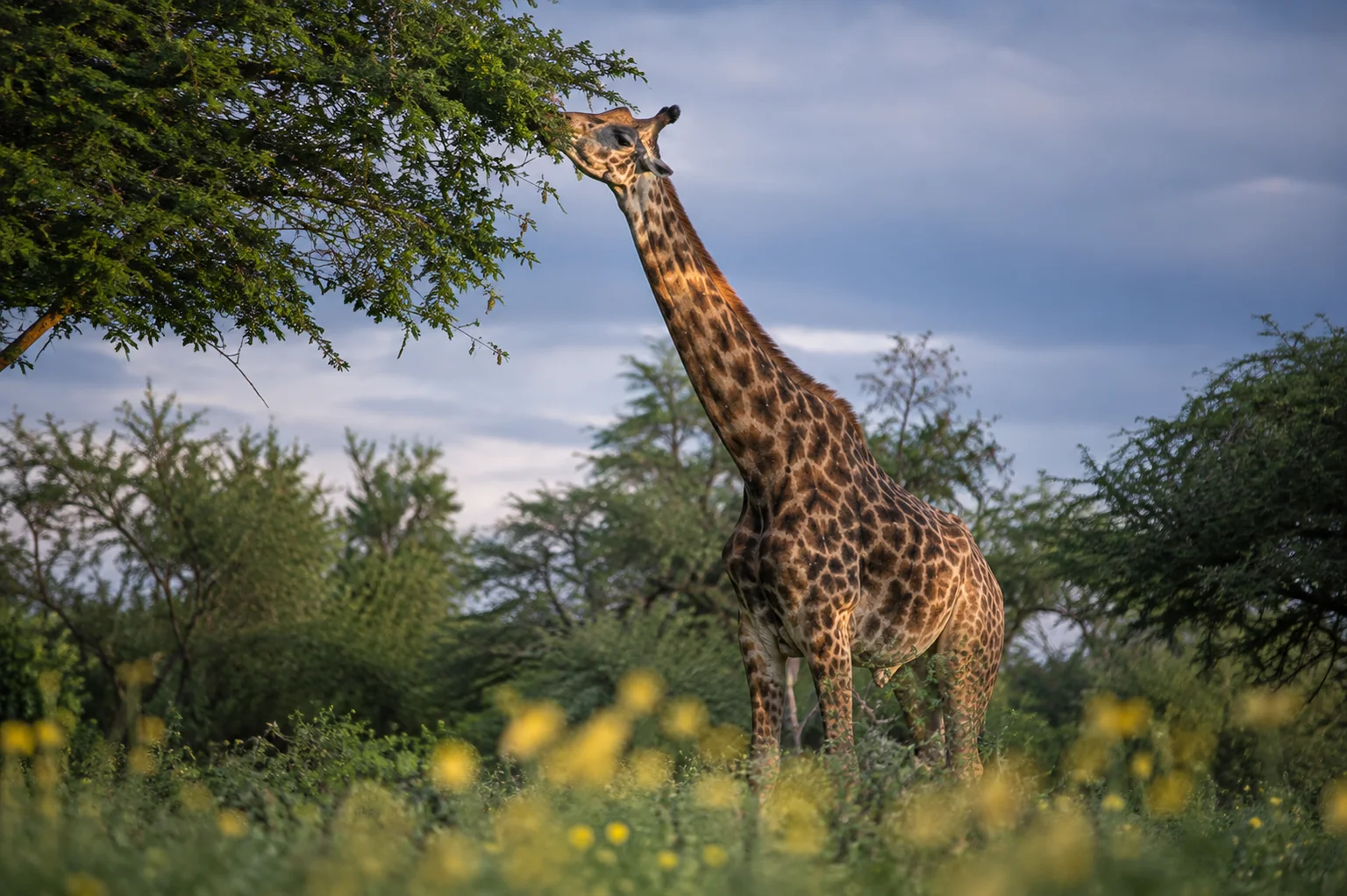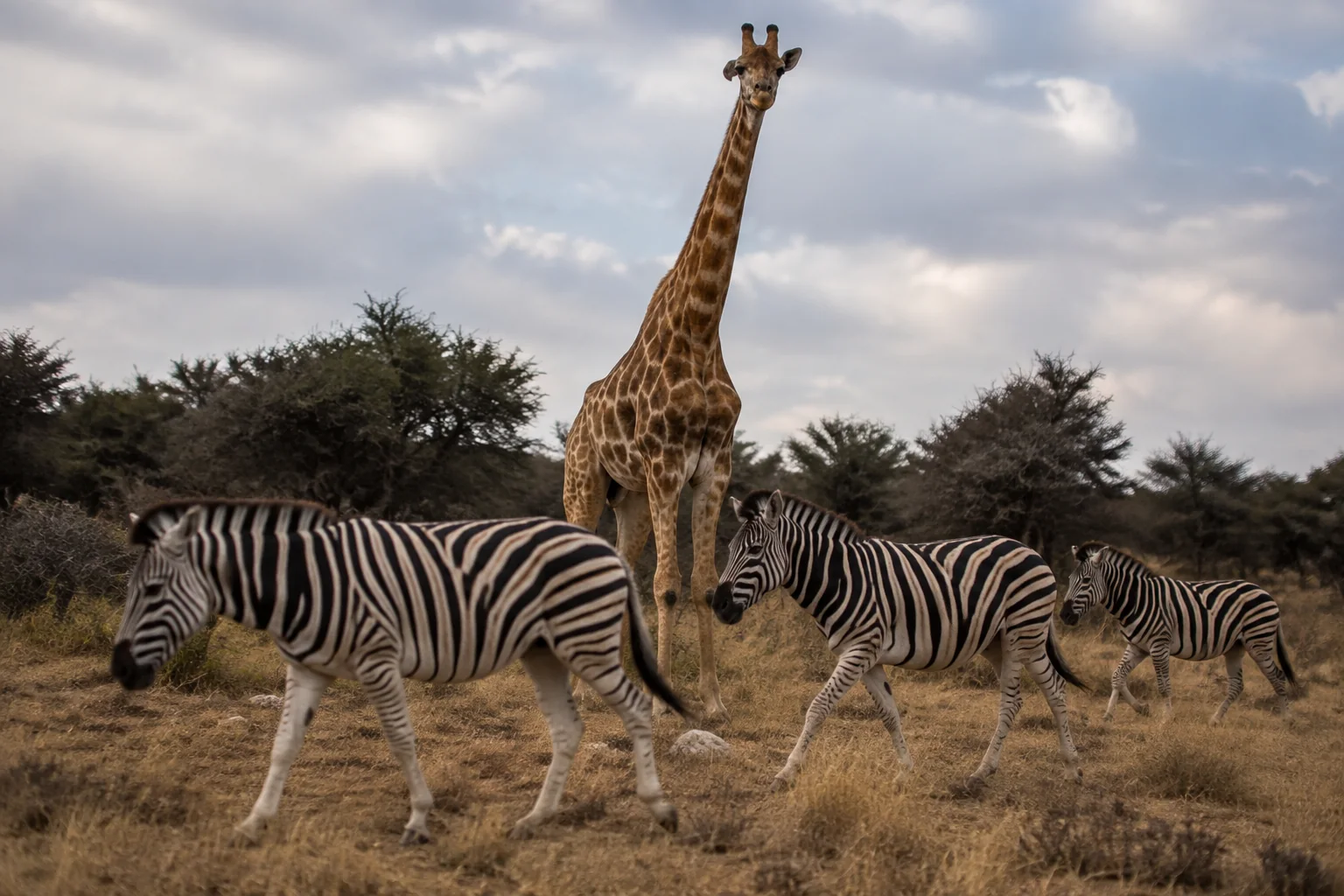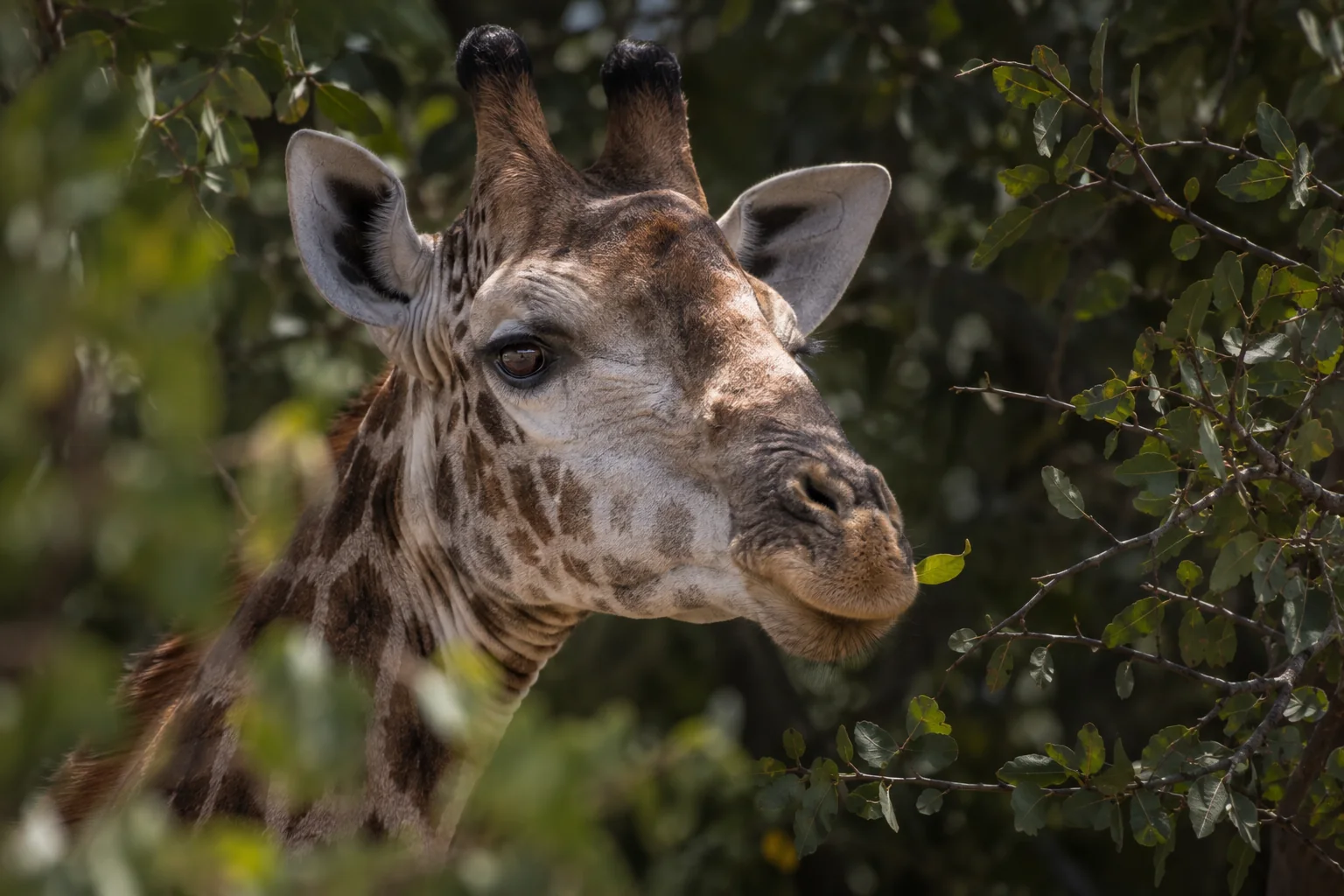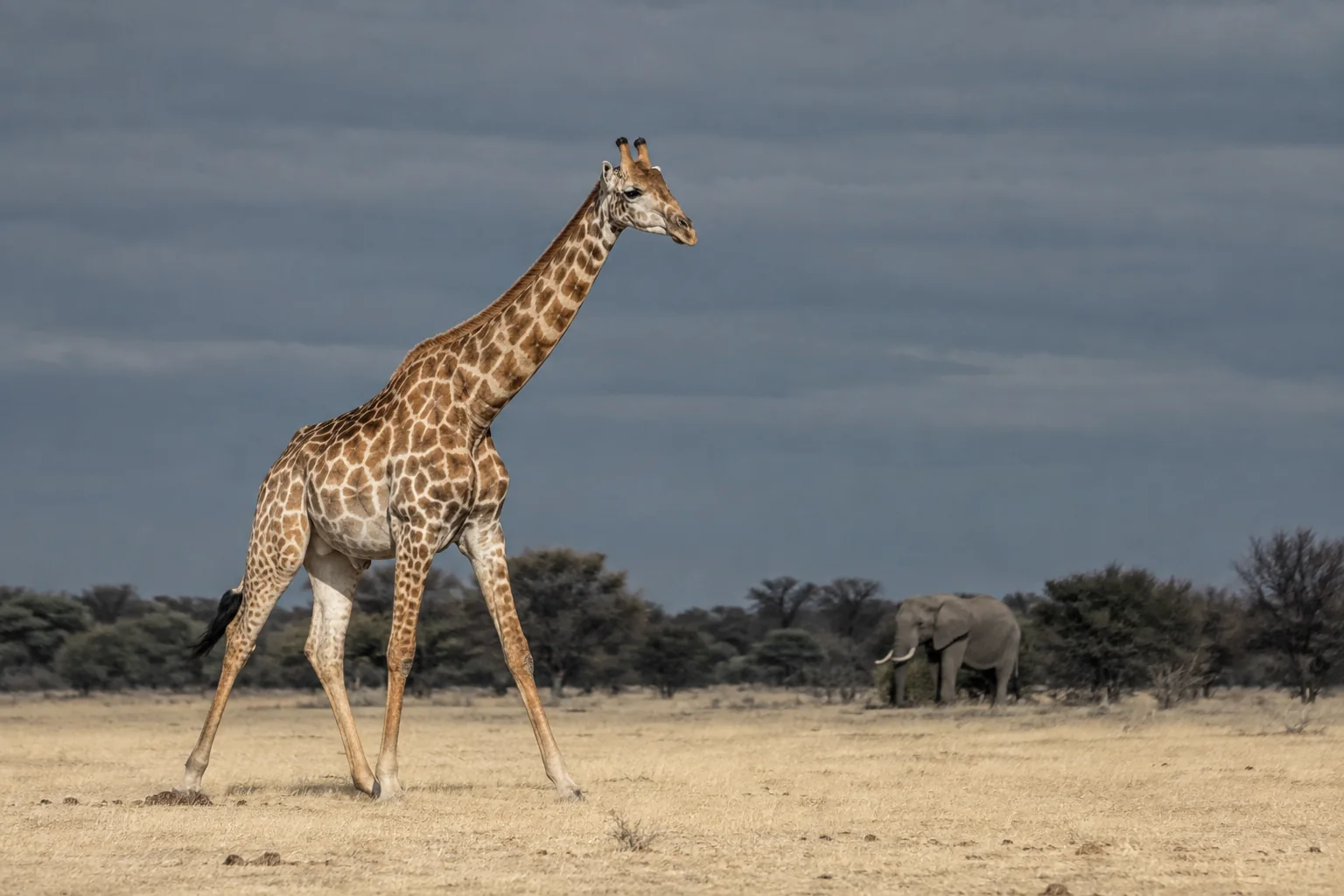
An elephant can help an invasive cactus spread by moving its seeds. It can also damage the same cactus by uprooting or eating it. Seeing either behaviour does not tell a conservation manager which effect matters more. The relevant question is what happens to the cactus population after years of both processes operating together.
Harry Wells and colleagues addressed that question using long-running herbivore exclusions in central Kenya. The result ran against the assumption that animals associated with seed dispersal must be helping the invasion overall. Cactus generally accumulated more strongly where wild herbivores were kept out. Access by the native herbivore community appeared to restrain the invasion, even though it did not stop it.
For giraffe conservation, the finding is also a lesson in interpreting grouped effects. Some fences excluded elephants and giraffes together. Those comparisons identify an effect of the largest herbivores as a group; they do not establish that giraffes themselves controlled cactus. The authors explicitly considered elephants the likelier direct suppressors. The full study gives a strong reason to examine the ecological functions of an intact animal community while remaining precise about which animal did what.
Letting an invasion encounter different animal communities
The researchers used three established field experiments at Mpala in Laikipia: UHURU, KLEE and GLADE. Their fences had been manipulating herbivore access for roughly 13–26 years. The experiments differed in their soil, plot size, history and combinations of animals admitted, providing several opportunities to ask whether cactus responded consistently to missing herbivores.
At UHURU, treatments excluded all large mammalian herbivores, excluded the medium and largest herbivores while allowing the smallest, excluded only elephants and giraffes, or admitted the whole community. The other experiments provided related, rather than identical, comparisons. KLEE also manipulated cattle access. GLADE compared broad exclusions with open plots; two of its fences had been removed five years before cactus sampling, so those plots carried a history of exclusion followed by renewed access.
This design is more informative than comparing two places that happen to contain different numbers of animals. Exclusion deliberately changes access. But these were not three replicas of one perfectly uniform experiment, and the authors analysed the experiments separately. Soil and invasion history could influence how much cactus was present before herbivore effects became apparent.
In 2021 and 2022, the team measured each cactus’s height and canopy dimensions to estimate its volume. They then expressed total cactus volume per surveyed area. This captures more than a count: a few large, spreading plants can occupy much more space than numerous small ones. Most recorded plants were Opuntia stricta, with a much smaller number of O. ficus-indica.
At UHURU, the researchers also had repeated counts of cacti taller than one metre from 2009 to 2021, with several intervening years unsampled. The volume comparison offered a late snapshot of accumulated cactus. The count series showed how plants reaching the height threshold had accumulated through time.
Excluding the largest animals changed the trajectory
At UHURU, the modelled median cactus volume was about 21.2 cubic metres per hectare in plots excluding elephants and giraffes, compared with 5.8 cubic metres per hectare in open plots. That is roughly 3.7 times as much cactus volume under exclusion. The estimate carried uncertainty, but the model gave 95% posterior support to the direction of the difference.
The same comparison pointed towards higher cactus volume after megaherbivore exclusion at KLEE, although cactus was much scarcer there and uncertainty was wide. GLADE likewise supported higher volume after broad herbivore exclusion. These differences across experiments matter: the study supports a recurring suppressive role, rather than one exact reduction that can be applied to every soil or landscape.
The time series strengthens that interpretation. No cacti above one metre were recorded at UHURU’s starting survey. By 2021, the fitted model estimated about 13 additional plants per surveyed plot where elephants and giraffes had been excluded, relative to open plots. Treatments excluding additional herbivores also accumulated more tall cacti.
That starting condition refers to plants above the survey’s height threshold. It does not demonstrate that no cactus seed or small plant existed anywhere inside the plots. Nor do the figures measure every possible pathway separately. They measure the accumulated outcome of establishment, growth, damage and survival under different access regimes.
The pattern was not simply that each additional animal group produced the same increment of control. Smaller herbivores appeared to contribute in some comparisons, but results varied, especially where cactus was rare. The exclusion of elephants and giraffes accounted for much of the observed effect, making the identity of the excluded group more informative than a simple count of missing species.
Why this is not proof that giraffes eat cactus
The experiment did not contain a treatment that removed giraffes while leaving elephants, paired with another that did the reverse. Their effects therefore cannot be separated statistically by the megaherbivore comparison.
The paper supplies direct photographic evidence of elephants uprooting and consuming cactus near the experimental sites. Those images show a mechanism that can damage plants, but they do not measure how often it happens across the landscape. The authors also report observations involving other mammal species and note that the frequency and intensity of consumption remain uncertain.
Giraffes, by contrast, were not shown directly consuming or destroying cactus in this study. Their possible contribution could include indirect changes to other vegetation, but that pathway was not isolated either. It would be misleading to turn the finding into a claim that giraffes are proven cactus-control agents.
Indirect mechanisms are plausible because a cactus does not grow independently of surrounding plants. Trees may alter shade, soil conditions, protection from browsing or visits by seed dispersers. An animal that changes those trees can affect cactus without taking a single cactus bite. The study’s long-term comparisons include the combined consequences of such pathways, while leaving their relative contributions unresolved.
That is the distinction between identifying an ecological effect and explaining all of its mechanisms. Here, the evidence for the community’s overall suppressive effect is stronger than the evidence assigning a share to every member of that community.
A wider landscape told a compatible story
The team also compared modelled cactus occurrence with modelled herbivore distributions across 6,150 square kilometres of surrounding savanna. At that scale, cactus occurrence tended to be lower where herbivore species richness was higher. The negative relationship with elephant occurrence was stronger.
These were comparisons among modelled landscape estimates, not another fencing experiment. Differences in land use, vegetation and history could affect both animals and cactus. The landscape result is therefore supporting consistency, rather than an independent causal proof that adding a particular number of species would reduce cactus by a predictable amount.
A later camera-trap study by Peter Stewart and colleagues adds a useful complication. It found that elephants were more likely to use sites with greater cactus presence at both of the spatial scales examined. That local association does not overturn the earlier exclusion result. An animal can be attracted to a plant and damage it enough that fewer plants accumulate over years than would accumulate without that animal.
The studies ask different questions: where animals use habitat over an observation period, and how cactus populations develop under prolonged exclusion. Treating attraction as equivalent to assistance, or a negative landscape correlation as equivalent to avoidance, would confuse those questions. Our commentary on cactus and habitat use follows the later study’s scale-dependent results, including those for giraffes.
Resistance is not immunity
Cactus numbers still increased in UHURU plots accessible to the full herbivore community. The animals reduced the invasion relative to exclusion; they did not eliminate it. That qualification changes the management implication. Conserving or restoring native herbivores may contribute to invasion resistance, but this experiment does not show that wildlife alone can replace monitoring or other control measures.
Nor did the study test a programme of releasing giraffes or elephants into a heavily invaded site. Most comparisons concerned the consequences of long-standing access or exclusion. The two GLADE plots where fences had been removed offered a limited additional history, not a general demonstration of rapid reversal after reintroduction.
The most defensible conservation insight is that losing native herbivores can remove an existing check on an introduced plant. That function can be missed if attention rests only on the animals’ visible role in transporting seeds. An intact community may deliver a net outcome different from any one encounter suggests.
For giraffes, belonging to that community is ecologically important without requiring an unsupported claim of individual responsibility. The experiment makes the larger herbivore group’s contribution visible. Determining how much comes from elephant feeding, physical disturbance, giraffe effects on other plants, or interactions among those processes remains the next scientific task.
Sources
Harry B. M. Wells, Ramiro D. Crego, Jesse M. Alston, S. Kimani Ndung’u, Leo M. Khasoha, Courtney G. Reed, Abdikadir A. Hassan, Samson Kurukura, Jackson Ekadeli, Mathew Namoni, Peter S. Stewart, Duncan M. Kimuyu, Amelia A. Wolf, Truman P. Young, Tyler R. Kartzinel, Todd M. Palmer, Jacob R. Goheen and Robert M. Pringle (2023). “Wild herbivores enhance resistance to invasion by exotic cacti in an African savanna.” Journal of Ecology 111, 33–44. Full primary paper.
Peter S. Stewart, Russell A. Hill, Ayub M. O. Oduor, Philip A. Stephens, Mark J. Whittingham and Wayne Dawson (2025). “Multi-Species Impacts of Invasive Opuntia Cacti on Mammal Habitat Use.” Ecology Letters 28, e70163. Full primary paper.