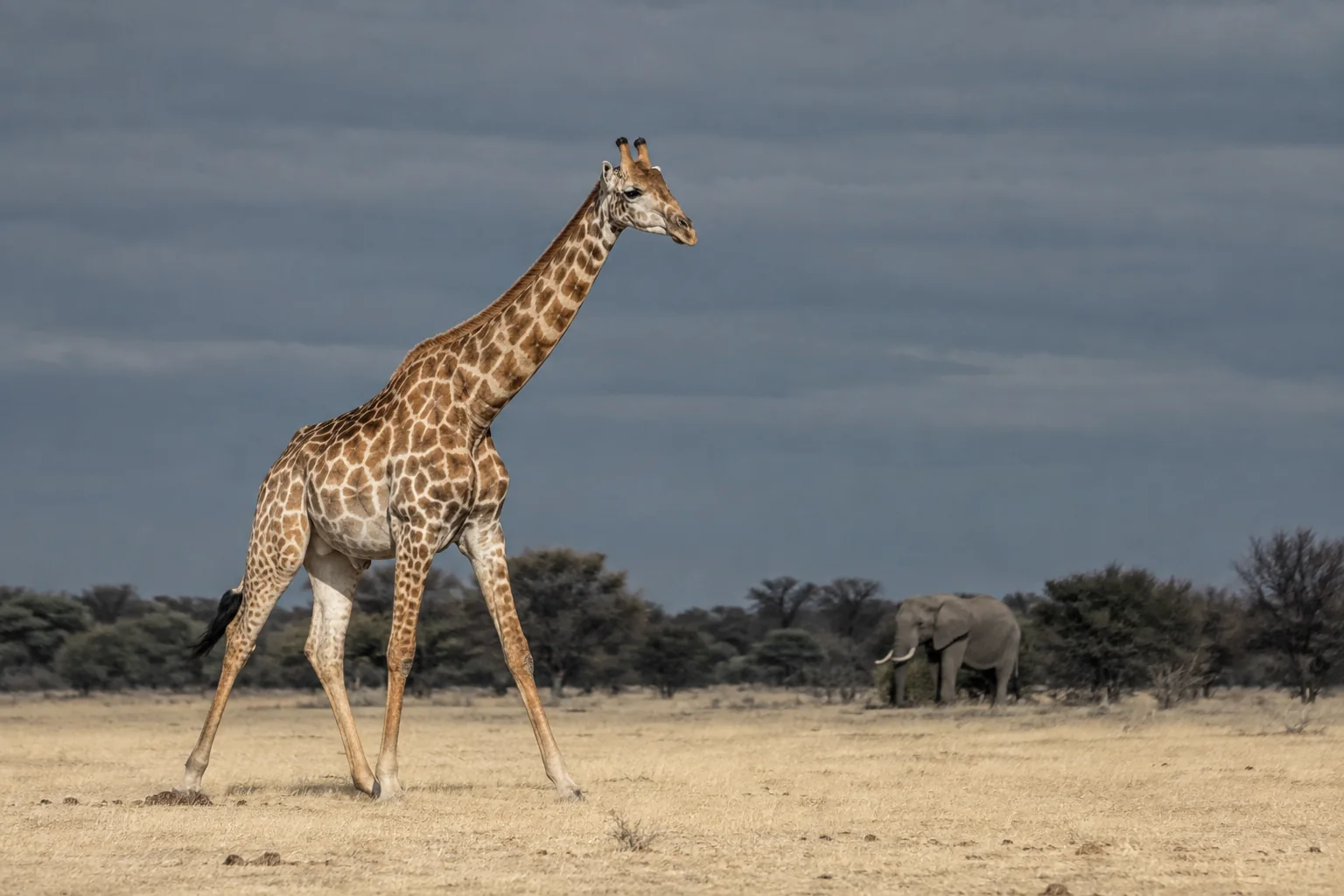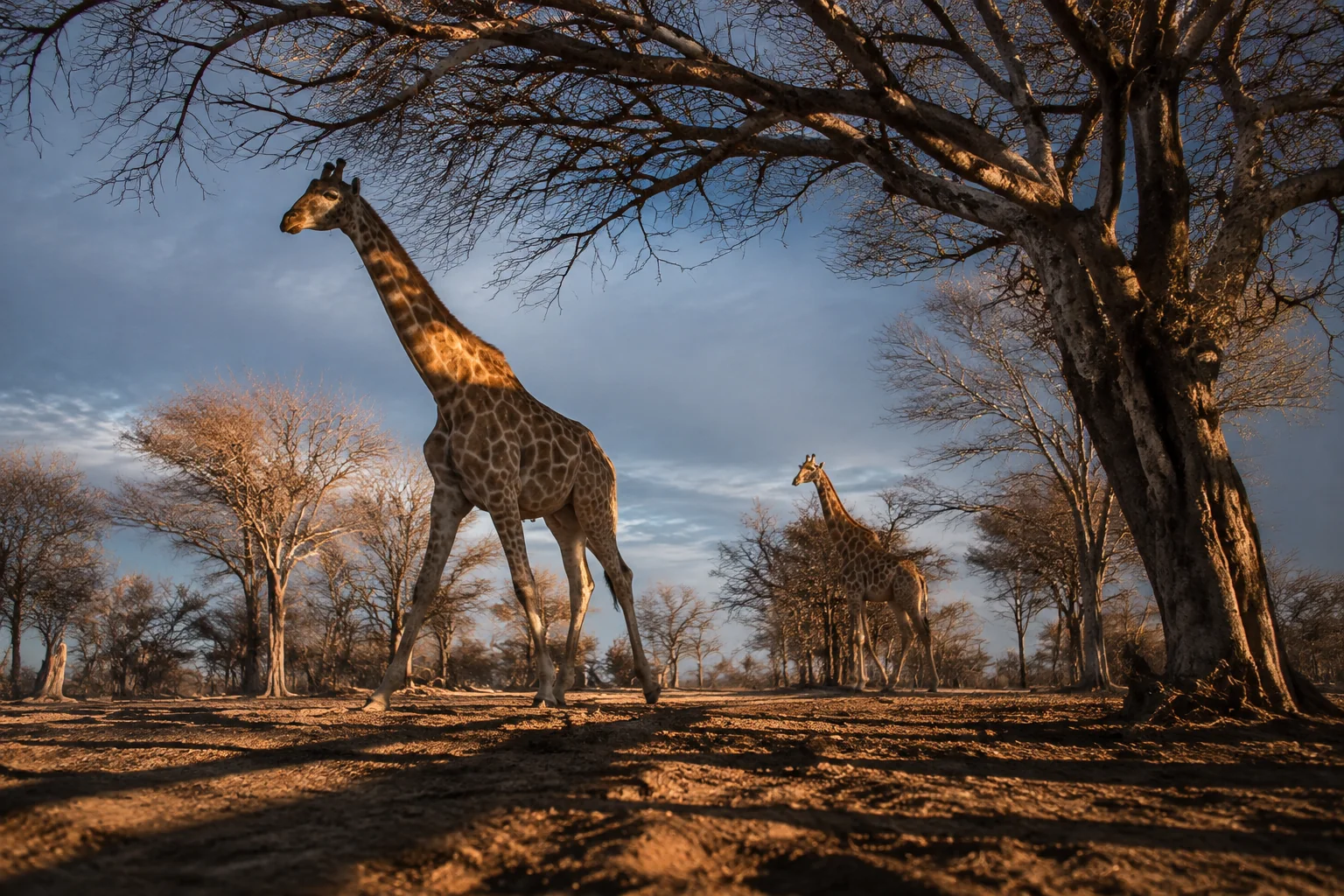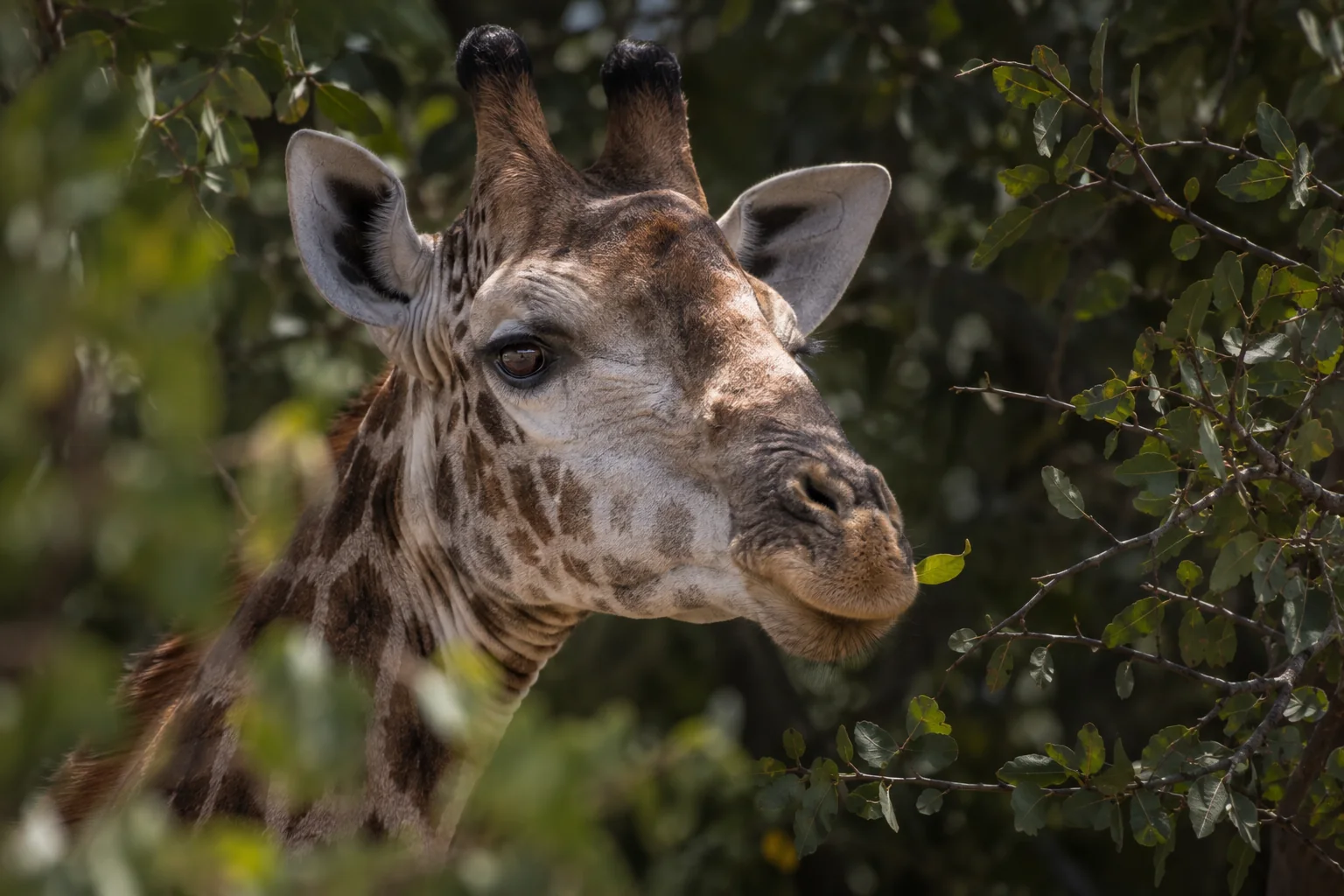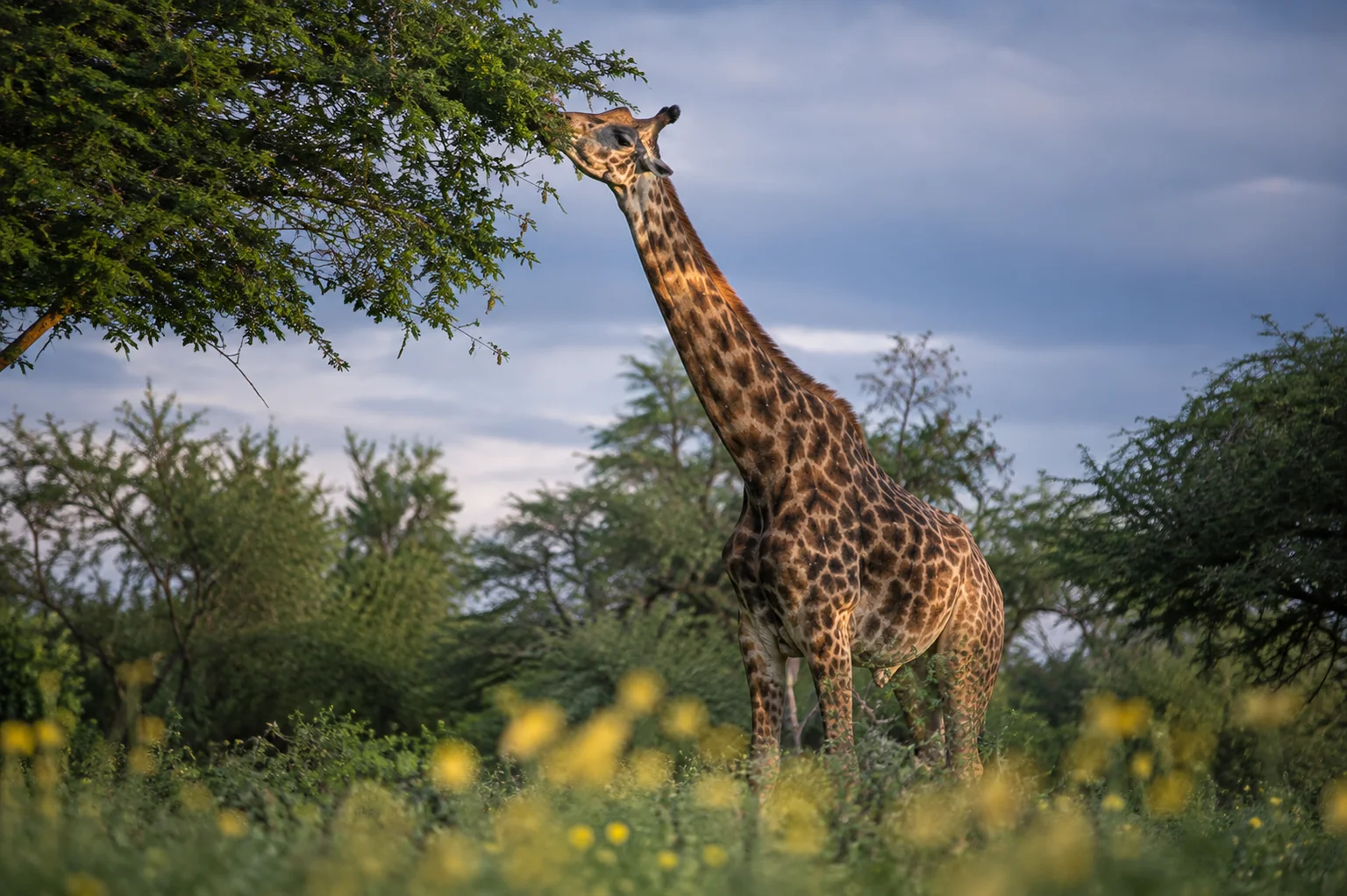
A giraffe can use a landscape containing invasive cactus while spending less time near its densest patches. That possibility is easily lost when conservation questions are phrased as whether an animal likes or avoids an invaded habitat. A camera-trap study in Kenya found that, for giraffes, the answer depended on how much of the surrounding landscape the researchers considered.
During January–April 2021, reticulated giraffes were less likely to use camera sites with more cactus immediately around them. Yet they were more likely to use sites situated within broader squares containing more cactus. The two associations pointed in opposite directions without contradicting one another: they described different spatial scales.
Peter Stewart and colleagues’ 2025 study of twelve mammal species shows why an invasive plant’s effect cannot always be captured by a single map of animal presence. The findings concern where animals used habitat over the sampling period. They do not show whether cactus reduced giraffe survival, how many giraffes left the region, or whether every heavily invaded area was unsuitable.
Comparing invaded patches with their neighbours
The study took place at Mpala and Loisaba in Laikipia, where invasive Opuntia cacti occurred at varying densities. The researchers selected subregions containing both scattered plants and more heavily invaded areas. Within selected 500-by-500-metre squares, they placed cameras to contrast relatively high cactus density with a nearby lower-density site.
The nearby comparison helped reduce the chance that the study would merely contrast unrelated landscapes. A heavily invaded site and a less invaded neighbour were more likely to share aspects of their wider setting than sites far apart. They were still observational comparisons: the team did not randomly add or remove cactus and then watch animals respond.
The researchers sampled 101 camera sites in 46 squares during January–April, and a smaller set of 27 sites in 14 squares during October–November. The first period was predominantly dry and the second wetter. Different sampling effort and environmental conditions mean the two periods should not be treated as equally precise, interchangeable tests of one fixed response.
Around each camera, the team estimated cactus cover within a ten-metre radius. Separately, transect surveys supported estimates of cactus abundance and volume across the larger grid squares. Those measurements represent different things: local cover describes the immediate patch, whereas the grid estimate describes the surrounding neighbourhood. The grid survey reached 41 of the original 46 squares, with pandemic constraints limiting its coverage.
These two scales were essential to the study’s design. An animal may need to move through a broadly invaded area to reach food, shade or other resources, while choosing comparatively open places within it. A survey using only the larger scale could miss that selection among patches.
A photograph can answer more than one question
The cameras produced more than 1.7 million images. Automated screening and volunteer classifications narrowed the material to usable species detections, with an expert-classified subset used to assess classification performance. Photographs containing people were removed from the wildlife analysis.
The researchers then distinguished three aspects of habitat use. Occupancy meant the probability that a camera site was used at least once during the relevant period. Daily detections described how much camera activity was recorded. The proportion of detections at night addressed timing. These are related quantities, but they are not equivalent.
For a mobile animal such as a giraffe, occupancy does not imply residence in a small camera patch. One visit can establish use, while a different site can receive repeated visits. Nor does a larger number of detections necessarily mean a larger population. The same animals can return, linger or pass a camera in different ways. This study did not identify each giraffe and estimate a regional population from its encounter history.
The occupancy models included a detection component because an animal’s presence does not guarantee a photograph. Temperature and camera model could affect the chance of detection. Other parts of the analysis considered environmental variables such as distance to roads and rivers, livestock detections and native vegetation. Spatial modelling also addressed similarities among nearby sites.
Those steps made the comparison more informative than a raw tally of photographs. They did not turn it into a controlled experiment or remove every possible difference between high- and low-cactus sites.
The giraffe result changes when the frame widens
In January–April, the occupancy model associated greater cactus cover around a camera with lower giraffe site use. In the same period, greater cactus volume across the surrounding grid square was associated with higher giraffe site use. The paper’s figure displays those results side by side: the local relationship slopes down, and the wider relationship slopes up.
The result allows a more specific interpretation than either giraffes avoid cactus or giraffes are attracted to cactus. Giraffes could be using landscapes where cactus occurs while selecting against the more invaded patches inside those landscapes. That explanation is consistent with the pattern, but the study did not follow individual decisions closely enough to demonstrate exactly why it occurred.
The October–November giraffe relationships were much less clear. Likewise, the analysis of daily detections found only a weak negative relationship with local cactus during January–April. A strong claim of year-round displacement would therefore go beyond the results.
The difference between occupancy and detections is useful here. A site can remain part of an animal’s usable landscape while its intensity of use changes. Conversely, a pattern in the probability of at least one visit need not imply a comparable change in total use. Combining the measures can reveal subtler responses than presence alone, but it does not provide a demographic outcome such as survival or recruitment.
Other mammals did not supply a universal rule
The team selected species that differed in body size, food use and feeding ecology. Some, including elephants and olive baboons, were known in the study system as cactus-fruit consumers. Giraffes were included among herbivores not known to consume the fruit.
Elephant and baboon occupancy increased with cactus at both spatial scales in both seasons. Other mammals showed a mixture of positive, negative and uncertain responses. Even closely related grazers did not respond identically across all measures and seasons.
This variation is important for interpreting the giraffe result. An invaded patch can supply food or cover to one species while obstructing movement or access for another. A positive response by some wildlife does not demonstrate that invasion benefits the community overall. Equally, a negative response by one species does not establish that every mammal abandons the area.
The authors proposed physical changes in habitat structure and the distribution of resources as important mechanisms. Dense cactus can alter access and visibility; fruit can provide a resource for animals that eat it. Those possibilities are biologically plausible, but the study did not directly measure giraffes’ movement costs, perception of risk or food intake within the stands.
Accounting for vegetation did not resolve every mechanism
The researchers compared models with and without broad measures of native vegetation. In most cases, the estimated cactus relationships were similar. Under the assumptions laid out in their causal model, that offered little support for effects operating mainly through changes in broad cover categories such as grass and shrubs.
It did not show that native plants were irrelevant. Species composition within those categories could still matter, and plant cover does not necessarily measure accessible food. Grass or browse can be present among cactus while being difficult for an animal to reach. The measurements also did not describe every nutritional or structural difference between patches.
A further assumption concerned the direction of influence. The models treated cactus as affecting animal habitat use. Over longer periods, animals can themselves change cactus populations, so the relationship may run both ways.
That is more than a theoretical caveat. In a separate long-term exclusion study in the same region, Harry Wells and colleagues found that cactus generally accumulated more strongly where wild herbivores were excluded. Elephants and giraffes were excluded together in key treatments, so that experiment could not assign their individual contributions. It nevertheless demonstrated that animal access can affect the plant side of the relationship.
The camera study’s authors argued that behavioural responses can occur faster than those longer-term vegetation changes. This makes their interpretation reasonable, but the short timescale does not prove that historical animal use had no influence on the cactus distribution they sampled. Our commentary on the exclusion experiments explains what the longer-term comparisons establish.
What this changes for habitat conservation
The giraffe finding warns against reading a coarse distribution map as evidence that invasion causes no problem. Animals may remain in an invaded square while losing access to some of its patches. It also warns against treating local avoidance as evidence that the entire surrounding landscape has become unusable.
For a management assessment, the distinction suggests examining both the broader distribution of giraffes and the places they actually use within invaded areas. Repeated measurements after cactus removal could test whether usable patches expand, while individual monitoring could connect habitat use to condition, reproduction or survival. These are next steps suggested by the study, not benefits that its observational comparisons already demonstrated.
The paper leaves a carefully bounded result: the same giraffes can appear positively or negatively associated with cactus depending on the spatial question being asked. Conserving their habitat requires understanding that pattern before turning a local observation into a claim about a whole landscape or population.
Sources
Peter S. Stewart, Russell A. Hill, Ayub M. O. Oduor, Philip A. Stephens, Mark J. Whittingham and Wayne Dawson (2025). “Multi-Species Impacts of Invasive Opuntia Cacti on Mammal Habitat Use.” Ecology Letters 28, e70163. Full primary paper.
Harry B. M. Wells, Ramiro D. Crego, Jesse M. Alston, S. Kimani Ndung’u, Leo M. Khasoha, Courtney G. Reed, Abdikadir A. Hassan, Samson Kurukura, Jackson Ekadeli, Mathew Namoni, Peter S. Stewart, Duncan M. Kimuyu, Amelia A. Wolf, Truman P. Young, Tyler R. Kartzinel, Todd M. Palmer, Jacob R. Goheen and Robert M. Pringle (2023). “Wild herbivores enhance resistance to invasion by exotic cacti in an African savanna.” Journal of Ecology 111, 33–44. Primary paper.