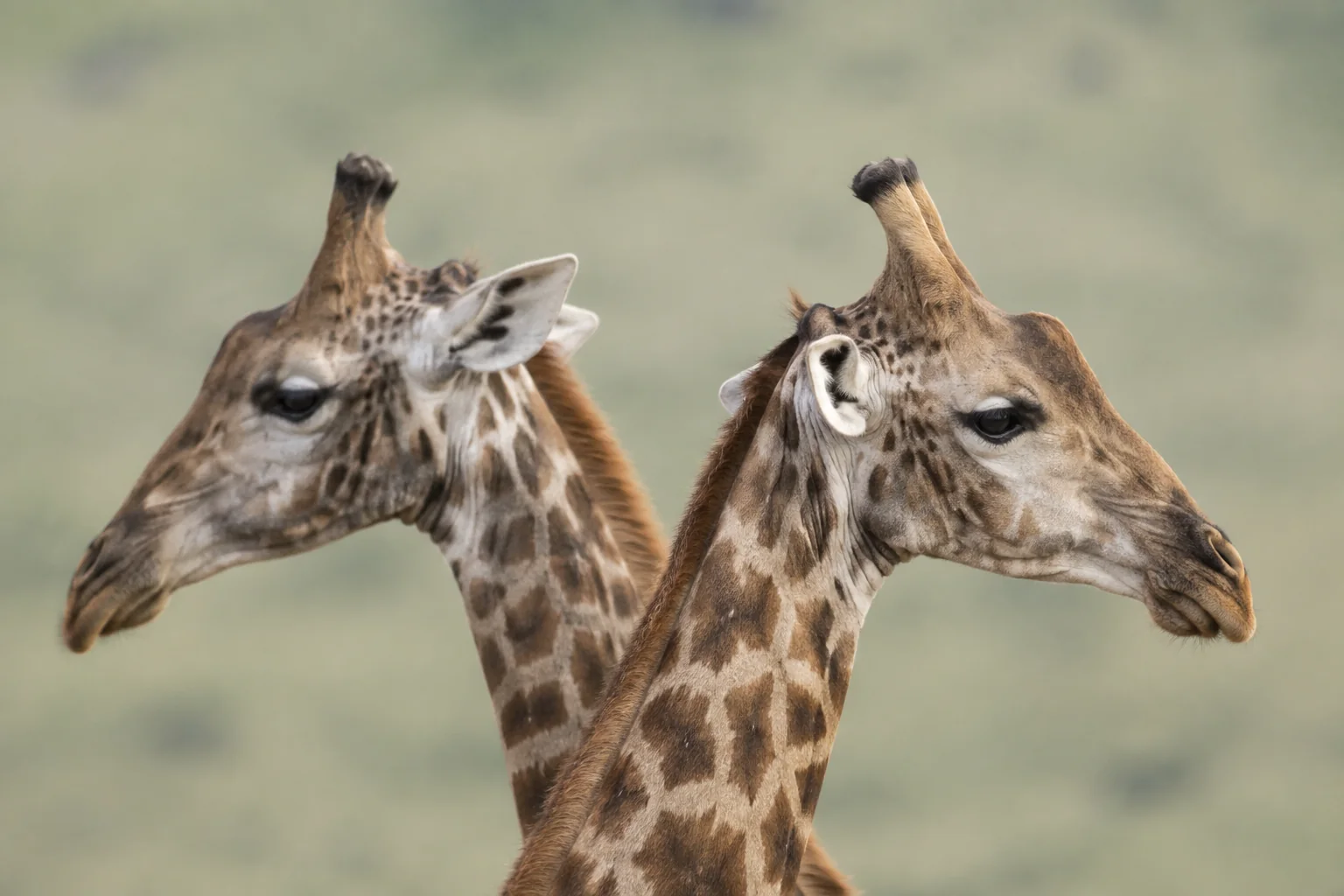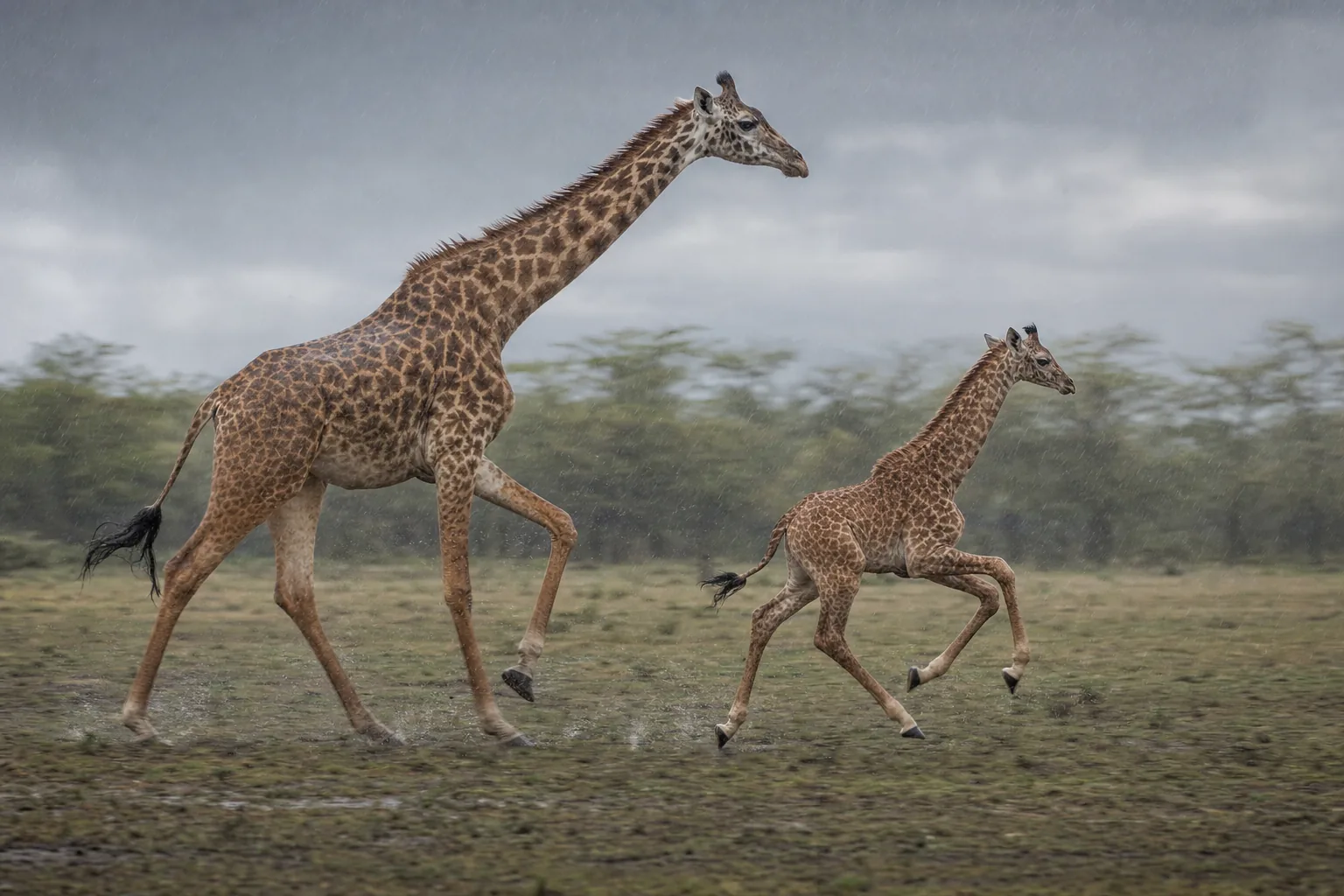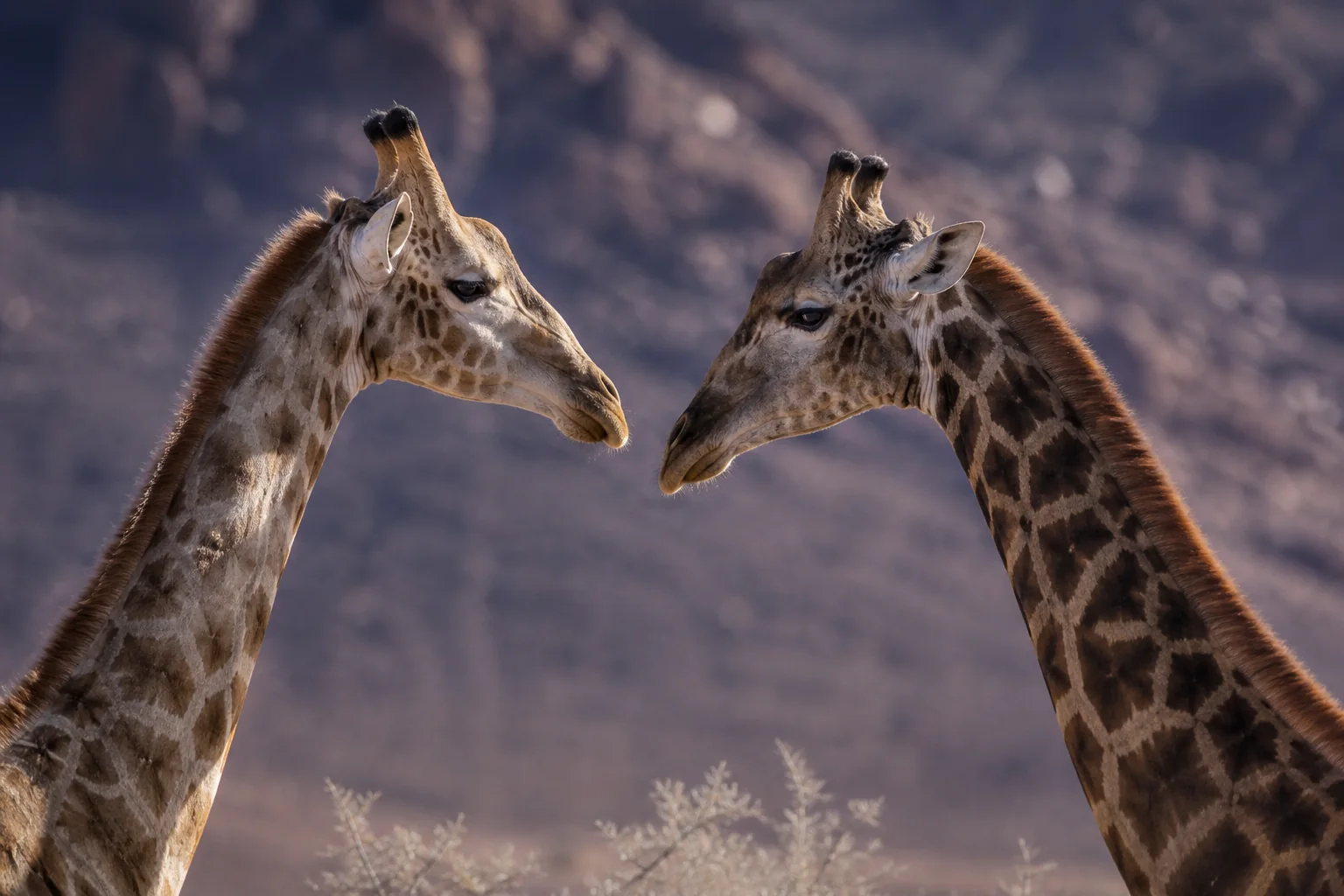
A male giraffe’s size changes slowly, but the way he behaves around females can change much faster. A mature bull may investigate females repeatedly during one observation period and show little sexual activity during another. If researchers see him only once, they risk mistaking a temporary phase for a lasting characteristic.
Peter A. Seeber, Patrick Duncan, Hervé Fritz and André Ganswindt investigated this problem in a 2013 study in Zimbabwe’s Hwange National Park. They combined observations of identifiable males with hormone measurements from their dung. That pairing allowed them to ask whether differences in courtship reflected only differences between males—or also changes within a male over time.
A search for females has changing costs
Giraffe groups split and merge, and females are not all ready to mate at the same time. A male seeking receptive females therefore faces a moving problem: he must encounter them, investigate their reproductive state and contend with other males.
The team described this as a roving reproductive strategy. Its costs include time spent searching and interacting rather than doing something else. A male might therefore benefit from concentrating reproductive effort into periods of higher activity. But observing less courtship does not automatically show that he has deliberately reduced his effort; the females and rivals around him also change.
To examine the pattern, the researchers spent 188 hours observing giraffes over 59 days between March and May 2011. They identified 73 bulls from their coat patterns and grouped them into three maturity classes using size, neck musculature, skull shape and ossicone development.
These were appearance-based categories, not known birth ages. The largest, most mature-looking class was expected to include the most dominant animals, but appearance and dominance were not interchangeable measurements.
Matching what males did to what they excreted
The observers recorded behaviours that made sexual investigation visible: examining females, testing urine, guarding a potential mate and attempting to mate. For each observation they also recorded the surrounding group.
The hormone component used 66 dung samples from 39 known males. These samples contained breakdown products of androgens, a group of hormones involved in male reproductive physiology. Measuring metabolites in dung allowed researchers to investigate endocrine activity without repeatedly capturing the giraffes for blood samples.
Dung is not a live display of the hormone level at the instant it is collected. It reflects hormone processing and passage through the body. The team therefore classified samples using sexual behaviour seen within a 72-hour window around collection, rather than demanding that a male court a female at the moment he defecated.
The two kinds of evidence were complementary. Behaviour indicated what a male was doing; hormone metabolites added information about the physiological state associated with it.
Mature bulls were active, but not continuously
The most mature-looking males showed the highest frequency of sexual behaviours. Their average androgen-metabolite concentrations also tended to be higher than those of less mature males. Within that top class, sexually active animals had higher concentrations than inactive animals.
The social setting mattered too. The largest males showed more sexual activity when other bulls were present, whereas the youngest-looking males showed the opposite pattern. Because rivals were not experimentally added or removed, this comparison indicates an association with company rather than proof that the presence of a rival caused the change.
The particularly revealing evidence came from repeated observations. Three mature males illustrated switches from sexual activity to inactivity over days or weeks, accompanied by marked declines in androgen-metabolite concentrations. A male’s broad physical category remained the same while his behaviour and hormone measurements changed.
The authors interpreted this as evidence for short, unsynchronised rut-like periods. A rut is a phase of heightened reproductive activity. Here, however, the phrase does not imply a predictable breeding season shared by every male, or a biological clock that resets exactly every fourteen days. The observations established flexible changes on roughly that timescale, not a regular cycle.
Hormones and social opportunities can influence each other
Higher hormone measures and more courtship occurred together, but the study did not determine which changed first. Hormones might help drive reproductive behaviour. Encounters with females or rivals might also alter endocrine activity, or both processes might respond to other conditions.
The authors explicitly raised this alternative in their discussion. Resolving it would require repeated sampling and observations sufficiently frequent to establish the order of changes. The small number of repeatedly sampled mature bulls is another reason to treat the pattern as a useful discovery rather than a complete schedule for the species.
Research on giraffe urine sampling adds a complementary part of the story. Lynette and Benjamin Hart observed males collecting urine directly from females before performing the flehmen response. Their Namibian observations concern investigation of a particular female; Seeber’s Zimbabwean study concerns changes in a male’s overall sexual activity. Together they distinguish the decision to invest in courtship from the information collected during an encounter.
Seeing the same male again changes the interpretation
A future study could follow known bulls across more seasons, matching behavioural changes, hormone patterns, local rivals and eventual paternity. That would help determine whether these active phases predict reproductive success and whether the same males repeatedly use similar tactics. Paternity would need to be measured separately: an attempted mating is not a confirmed offspring.
The immediate lesson concerns observation itself. Large males do not occupy a single, unchanging reproductive state. By returning to identifiable animals and linking their actions to non-invasive samples, Seeber and colleagues revealed variation that a snapshot of a giraffe group could easily conceal.
Sources
Peter A. Seeber, Patrick Duncan, Hervé Fritz and André Ganswindt (2013). Androgen changes and flexible rutting behaviour in male giraffes. Biology Letters 9, 20130396. DOI; research programme’s full paper.
Lynette A. Hart and Benjamin L. Hart (2023). Flehmen, Osteophagia, and Other Behaviors of Giraffes (Giraffa giraffa angolensis): Vomeronasal Organ Adaptation. Animals 13, 354. DOI and open paper.