A giraffe’s reproductive life involves a problem of timing. A male can encounter several females without knowing which one is approaching the brief period when mating could lead to conception. Following every female would take time and energy. Chemical information offers another possibility: a sample can reveal something that appearance alone does not.
In a 2023 paper, Lynette A. Hart and Benjamin L. Hart connected a familiar-looking courtship behaviour to an unusually direct way of obtaining that information. Their observations in Namibia showed males taking urine into their mouths while a female was urinating, then raising the head and curling the upper lip. The researchers also examined the passages leading from a giraffe’s mouth to a specialised sensory organ.
The sample arrives before the head rises
The team assembled 153 hours of observations at waterholes in Etosha National Park, made during field periods in 1994, 2002 and 2004. Waterholes brought giraffes together and allowed observers in vehicles to follow sequences of behaviour.
An encounter could begin with a male following a female, sniffing around her genital area or nudging her rump. Some females then spread their hind legs and braced themselves before urinating. The male placed his muzzle and tongue in the stream, collecting a small amount of urine. His lip curl sometimes began before he lifted his head away.
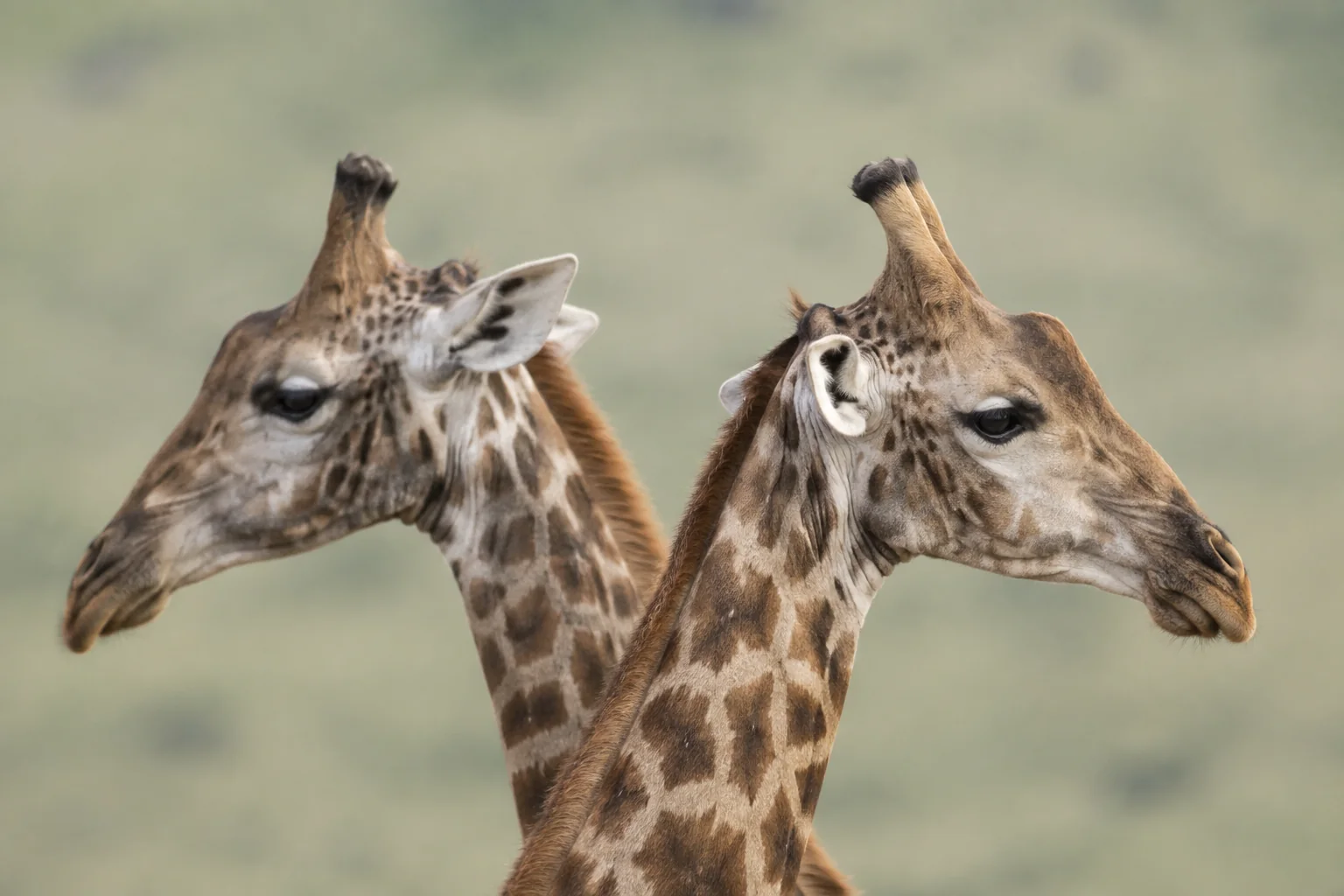
That curl is called flehmen. It is part of chemical investigation in several mammals, rather than simply an expression resembling a human grimace. The important event is the handling of a sample inside the mouth.
Among 102 recorded investigations involving adult males and females, the researchers observed 54 urination events and 51 subsequent flehmen responses. These are repeated encounters, not a census of 102 different animals. The sequence was common enough to describe systematically, while the fact that many approaches did not lead to urination shows that it was not an automatic response to every male.
The males were never observed sampling urine from the ground. For an animal with long legs and a heavy head, catching a fresh stream could avoid the awkward movement needed to reach the ground. It also connects a sample unambiguously to the female producing it. These are plausible advantages proposed by the authors; the observations did not compare the costs or success rates of alternative sampling methods.
A route from the mouth to chemical receptors
Ordinary smell is not the only way a mammal can investigate chemical cues. The vomeronasal organ contains sensory tissue that can respond to chemical signals, including those involved in reproduction. To understand what flehmen might accomplish, it helps to ask how material reaches that tissue.
In the two giraffe specimens examined, small structures on the roof of the mouth opened into ducts leading towards the paired vomeronasal organs. The connection from the nasal cavity was much less prominent. The anatomy therefore supported a strong oral route for delivering a fluid sample.
The researchers’ photographs and diagram bring the two kinds of evidence together: the behaviour supplies urine to the mouth, and the anatomical passages provide a possible onward route. A curled lip and raised head are the visible end of a process whose purpose is chemical investigation.
The study did not chemically analyse the urine, identify a particular fertility signal or measure how accurately a male classified a female’s reproductive state. It also examined only two anatomical specimens. Those limits leave a useful distinction: the work helps explain how information could be collected, without establishing the complete sensory mechanism or its accuracy.
Courtship requires more than access to a female
This sampling sequence adds detail to the broader story of giraffe reproduction. An encounter is an exchange of behaviour: the male approaches and investigates, while the female may move away or remain and urinate. The authors interpret this coordination as relevant to mate assessment. The observations alone cannot tell us a female’s intentions.
A complementary field study by Peter A. Seeber and colleagues followed changes in male sexual activity and androgen metabolites in Zimbabwe. Some mature males moved between active and inactive phases over days or weeks. That work concerns when males invest in courtship; the Hart study concerns how an active male investigates an individual female. The populations and observations are separate, and neither result supplies the missing fertility test for the other.
A useful next comparison would pair carefully timed observations of urine sampling with independently established female reproductive states. Researchers could then ask whether the male’s subsequent decision to remain with a female tracks her approach to fertility. Repeated observations would be necessary because a single lip curl does not reveal what information the animal obtained.
The distinctive achievement here is the connection between an observable courtship sequence and a physical route for chemical sampling. A male giraffe’s raised head is easier to understand once the preceding exchange—and the small sensory passages it may serve—comes into view.
Sources
Lynette A. Hart and Benjamin L. Hart (2023). Flehmen, Osteophagia, and Other Behaviors of Giraffes (Giraffa giraffa angolensis): Vomeronasal Organ Adaptation. Animals 13, 354. Paper and DOI; open full text.
Peter A. Seeber, Patrick Duncan, Hervé Fritz and André Ganswindt (2013). Androgen changes and flexible rutting behaviour in male giraffes. Biology Letters 9, 20130396. DOI; author research programme’s full paper.