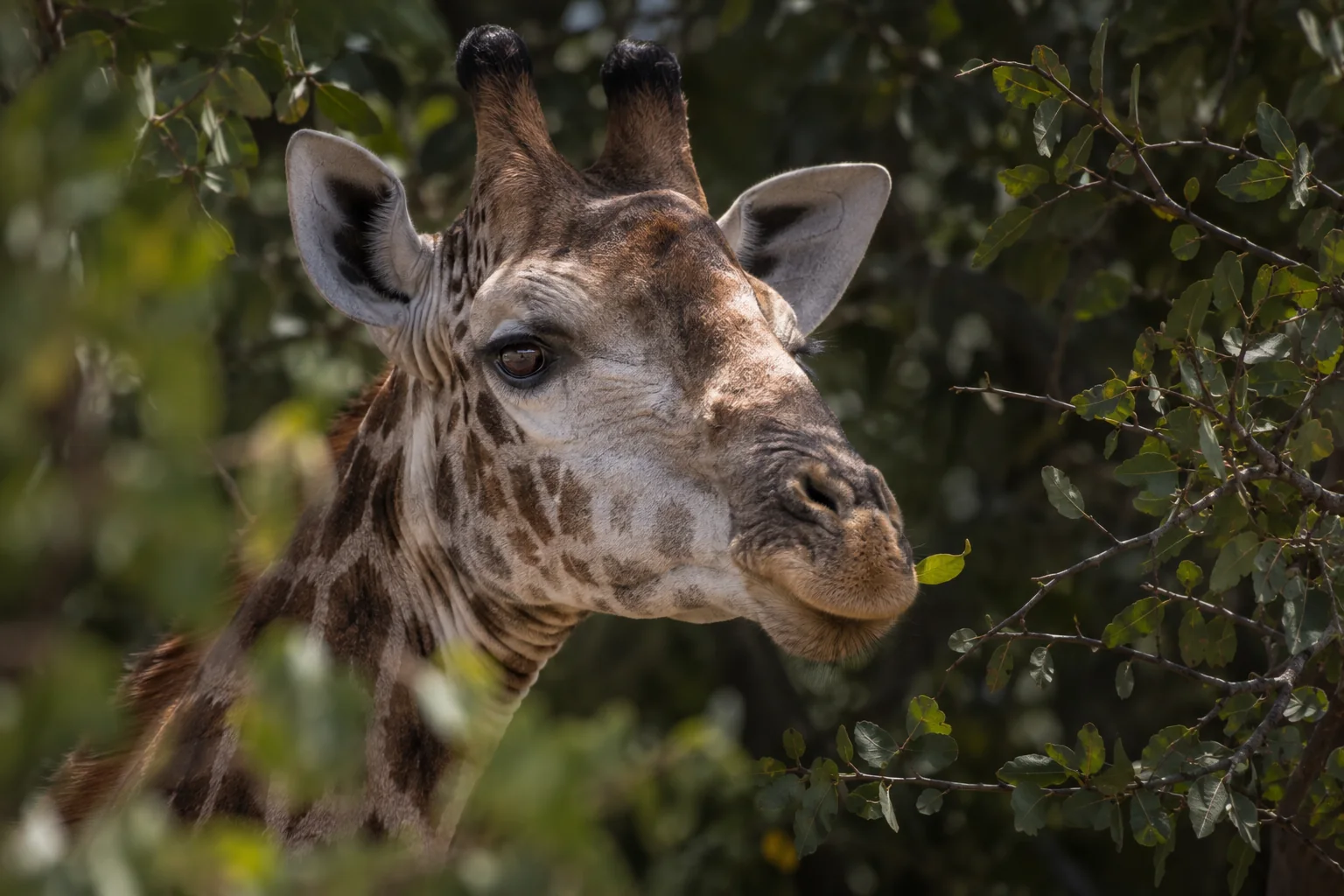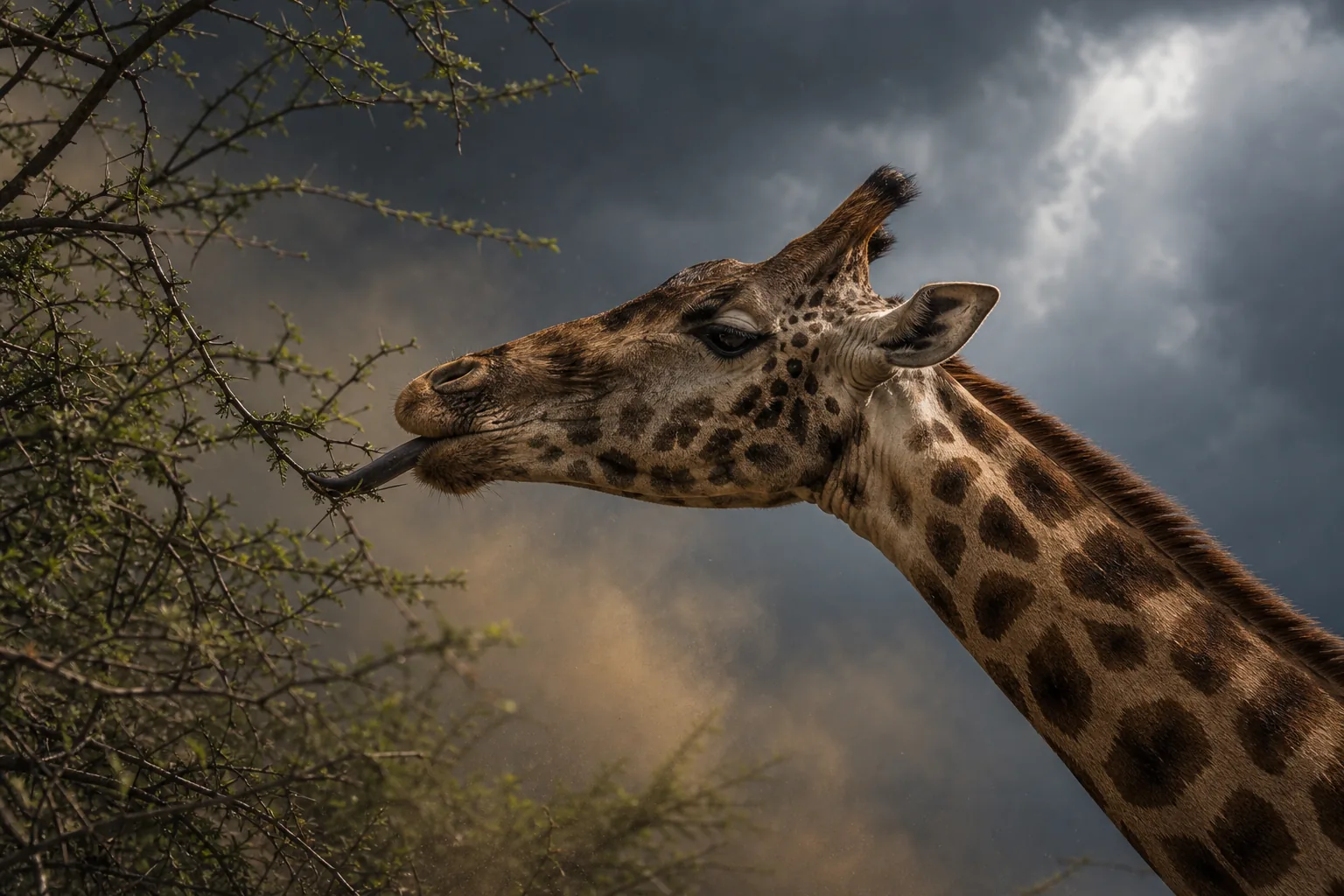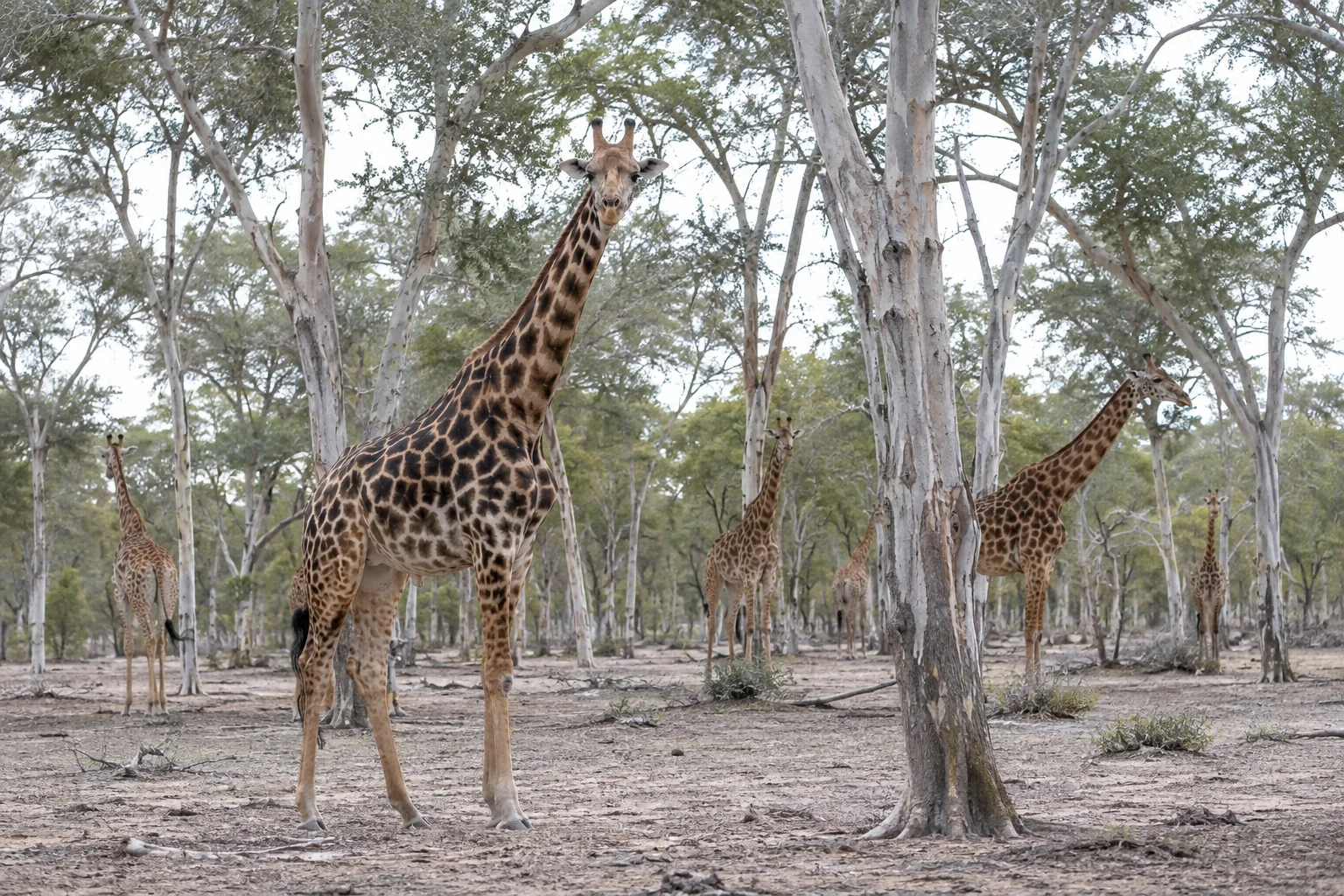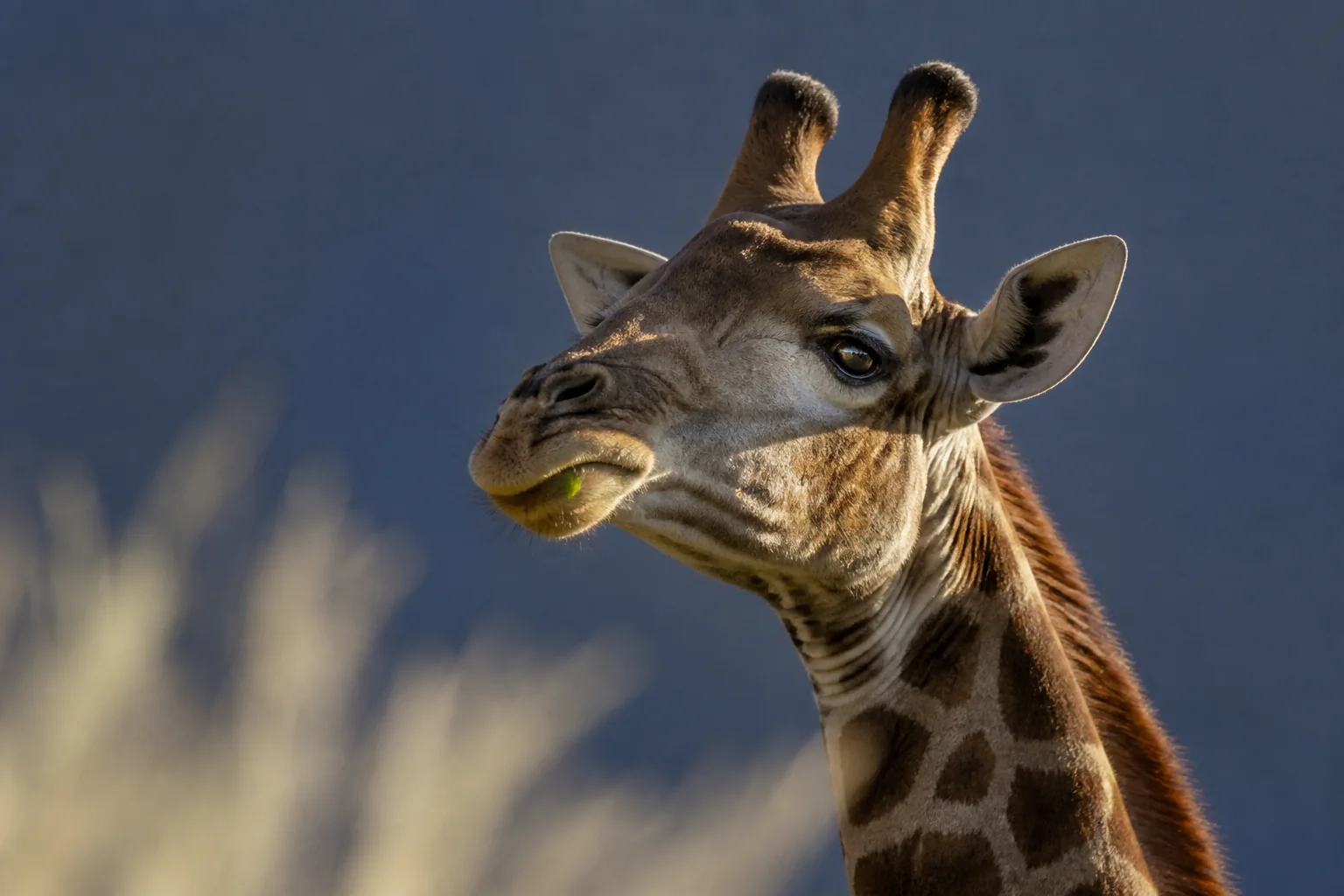
A giraffe can eat by plucking leaves from a branch, working its tongue into a feeder, or taking food that is already easy to reach. All three provide food. They ask different things of the animal's mouth and tongue, however, and may occupy its time differently.
Jason D. Wark and Katherine A. Cronin made that distinction central to their 2025 study of giraffes in eighteen US zoos. Among the 66 animals observed, those spending more time browsing or extracting food tended to spend less time making repetitive tongue movements or licking objects. The same clear relationship did not appear for other feeding.
That finding makes the question of feeding more specific. Alongside what a giraffe eats, researchers can ask what opportunities the food provides to perform the actions involved in obtaining it. The study identifies relationships worth investigating when designing those opportunities; it does not demonstrate that one husbandry change will produce the same outcome for every animal.
Building a picture beyond one zoo
An observation at a single zoo can reveal what an individual does, but it is difficult to separate the influence of that animal's history from its surroundings. Wark and Cronin coordinated a study across institutions with different herds, housing and management practices. That variation let them look for patterns extending beyond one setting.
Trained observers recorded a focal giraffe's behaviour at one-minute intervals during ten-minute sessions. They distinguished specific actions using shared definitions and passed agreement checks before collecting data. The resulting analysis included 8,330 sessions gathered over approximately a year at each zoo.
Those thousands of sessions are repeated observations of 66 animals, rather than thousands of independent giraffes. The researchers used models that accounted for individual animals within zoos while examining factors such as time of day, temperature, habitat size and public feeding programmes.
They also separated indoor and outdoor observations. The two settings differ in more than having a roof: temperature, space and daily routines can change together. Most observations occurred between 9am and 3pm, so the findings primarily describe that daytime window, not a complete twenty-four-hour life.
Three ways to obtain a meal
The distinction between feeding categories was practical and observable.
| Behaviour | What the observers recorded | What the animal was doing |
|---|---|---|
| Browsing | Stripping or plucking leaves or bark from branches, including eating the material obtained | Using the mouth and tongue to remove food from vegetation |
| Extractive foraging | Removing food from an enclosed object, such as a feeding bag or bucket | Manipulating food through access points in a feeder |
| Other feeding | Activities including eating from troughs, grazing, feeding from the ground or taking food from visitors | Obtaining food through routes outside the first two categories |
The observers separately recorded rumination: bringing previously swallowed food back up and chewing it again. They also recorded repetitive licking of stationary objects and repeated twisting or rolling movements of the tongue outside the mouth. Together, those last two behaviours formed the study's category of oral stereotypies.
This vocabulary matters because “the giraffe was using its tongue” could describe ordinary feeding or a repetitive action unrelated to obtaining food. The definitions allowed observers at different zoos to distinguish them consistently.
When the researchers compared each animal's average behaviour, more browsing was associated with less oral stereotypy. Extractive foraging showed a weaker negative association as well. They did not find a clear association with other feeding or rumination in that particular comparison.
The distinction between analyses is useful. In models comparing observation sessions while accounting for other factors, feeding and rumination were both negatively related to oral stereotypies. But the comparison between animals' average time budgets singled out browsing and extractive foraging. A relationship within observation sessions is not automatically the same as a difference between animals over the year.
What the repetitive behaviours can tell us
Repeated licking and tongue movements raise welfare questions, but watching one action does not reveal its cause or an animal's entire experience. Wark and Cronin discuss several possible influences, including limited foraging opportunities, past experience and responses to the immediate environment. Their study did not directly measure an animal's emotional state.
There is also a basic constraint on interpreting time budgets: time spent doing one activity is time unavailable for another. In this study, behaviours were recorded as mutually exclusive categories at each observation point. An association between more feeding and less repetitive activity therefore needs further investigation before it becomes a causal explanation.
The difference between feeding types is what makes the result especially interesting. If the only useful information were the total time spent eating, there would be less reason to distinguish browsing from readily accessible food. Instead, the results direct attention towards activities involving manipulation of food with the mouth and tongue.
A 2024 paper by the same researchers provides context for those individual differences. It described the same study population and found that every animal showed a stereotypic behaviour at least once, but the recorded frequency varied enormously. Three animals had only one recorded occurrence during the study, while one had 715.
Those counts concerned stereotypies as a broader category, including movement behaviours as well as oral ones. They show why “present or absent” is a limited description. An occasional event and a frequently repeated action can produce the same yes-or-no answer while representing very different patterns.
The 2024 and 2025 papers use the same underlying research programme and animals. The first describes the range of behaviour; the second investigates factors associated with it. Their agreement does not amount to replication in a second, independent group of giraffes.
Where public feeding fits
Fourteen of the eighteen zoos offered public feeding opportunities. In outdoor observations, giraffes at those zoos spent less time browsing and more time in the other-feeding category than giraffes at zoos without those programmes.
After accounting for the other factors in the browsing model, the estimated share of visible observation time spent browsing was about 10% at zoos with public feeding and 28% at zoos without it. These are model estimates for the observed conditions, rather than the fraction of every animal's entire day. They are also shares of time, not measurements of food weight or nutritional intake.
The authors suggest that easily offered foods may help explain the shift. Taking a readily accessible item can involve less manipulation than stripping leaves from branches. That is a plausible interpretation of the feeding categories, but the study did not assign zoos to introduce or remove public feeding. The programmes could coincide with other differences in how food was supplied.
Nor did the study establish a direct effect of public feeding on oral stereotypies. One result concerned the relationship between programmes and feeding behaviour; another concerned the relationship between particular feeding behaviours and stereotypies. Joining those associations into a proven chain of cause and effect would go beyond the experiment.
The practical research question is therefore quite focused: when public feeding takes place, what happens to opportunities for browsing and extracting food across the rest of that animal's day?
Time, temperature and space complicate the picture
Time of day was associated with all seven broad behaviours studied. Outdoor browsing and extractive foraging were more common in the morning, while higher temperatures were associated with more inactivity and less movement. A brief visit at one hour can therefore give a different impression from observation at another.
The researchers did not find that larger outdoor habitats were associated with more time moving. That finding does not settle whether space matters. Habitat area was measured as the total space at a zoo, which could differ from the area actually available to an individual when paddocks or stalls were divided. The study also did not measure the arrangement and complexity of resources throughout the space.
For feeding, those missing details are consequential. Two habitats of the same area could offer different numbers of accessible branches, different feeder positions and different ways to spread feeding opportunities over time. Area alone cannot describe those experiences. Wark and Cronin identify more detailed recording of habitat use and husbandry routines as ways to investigate them.
Testing whether changed opportunities change behaviour
A useful follow-up would observe the same giraffes before and after a defined change in browsing or extractive feeding opportunities, while recording food provision, season and daily schedules. Comparing different periods or groups would help distinguish the effects of that change from an unrelated shift in temperature or routine.
It would also need to follow individuals. The wide variation in repetitive behaviour means that an average response could conceal improvement in some animals and little change in others. Recording feeding actions alongside repetitive behaviours would show whether the intended opportunity was actually being used.
The contribution of this eighteen-zoo study is to make those next questions more precise. Feeding observations contain more information than whether an animal is eating. By distinguishing how giraffes obtain food, Wark and Cronin identified behaviours with different relationships to repetitive activity—and gave future studies a clearer target to test. The research-library record places their study alongside related work.
Sources
The research behind this story: Jason D. Wark and Katherine A. Cronin (2025). Factors shaping giraffe behavior in U.S. zoos: A multi-institutional study to inform management. PLOS One 20(5), e0324248. Published 29 May 2025. DOI: 10.1371/journal.pone.0324248. Read the full paper.
Jason D. Wark and Katherine A. Cronin (2024). The behavior patterns of giraffes (Giraffa camelopardalis) housed across 18 US zoos. PeerJ 12, e18164. DOI: 10.7717/peerj.18164. Read the full paper.