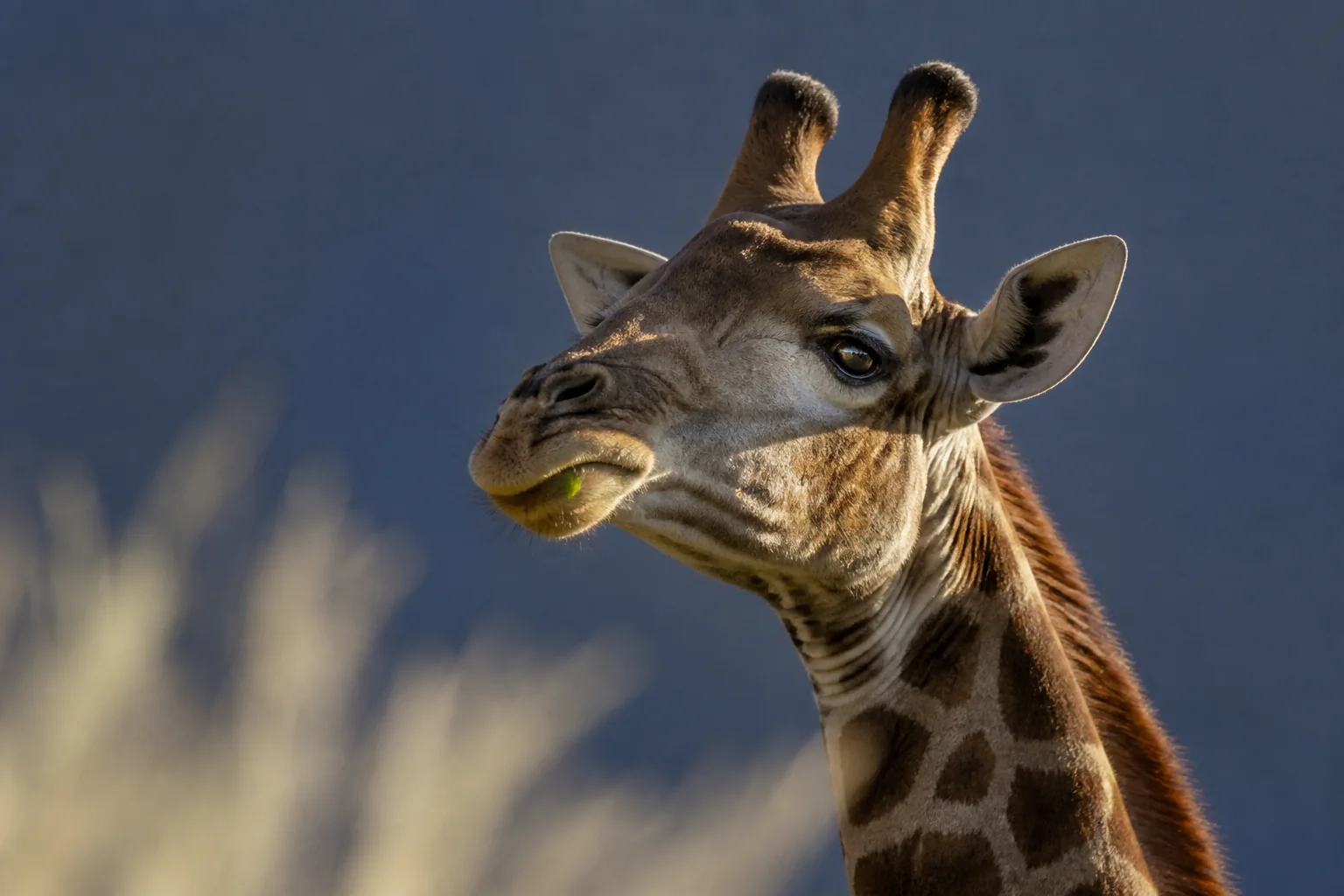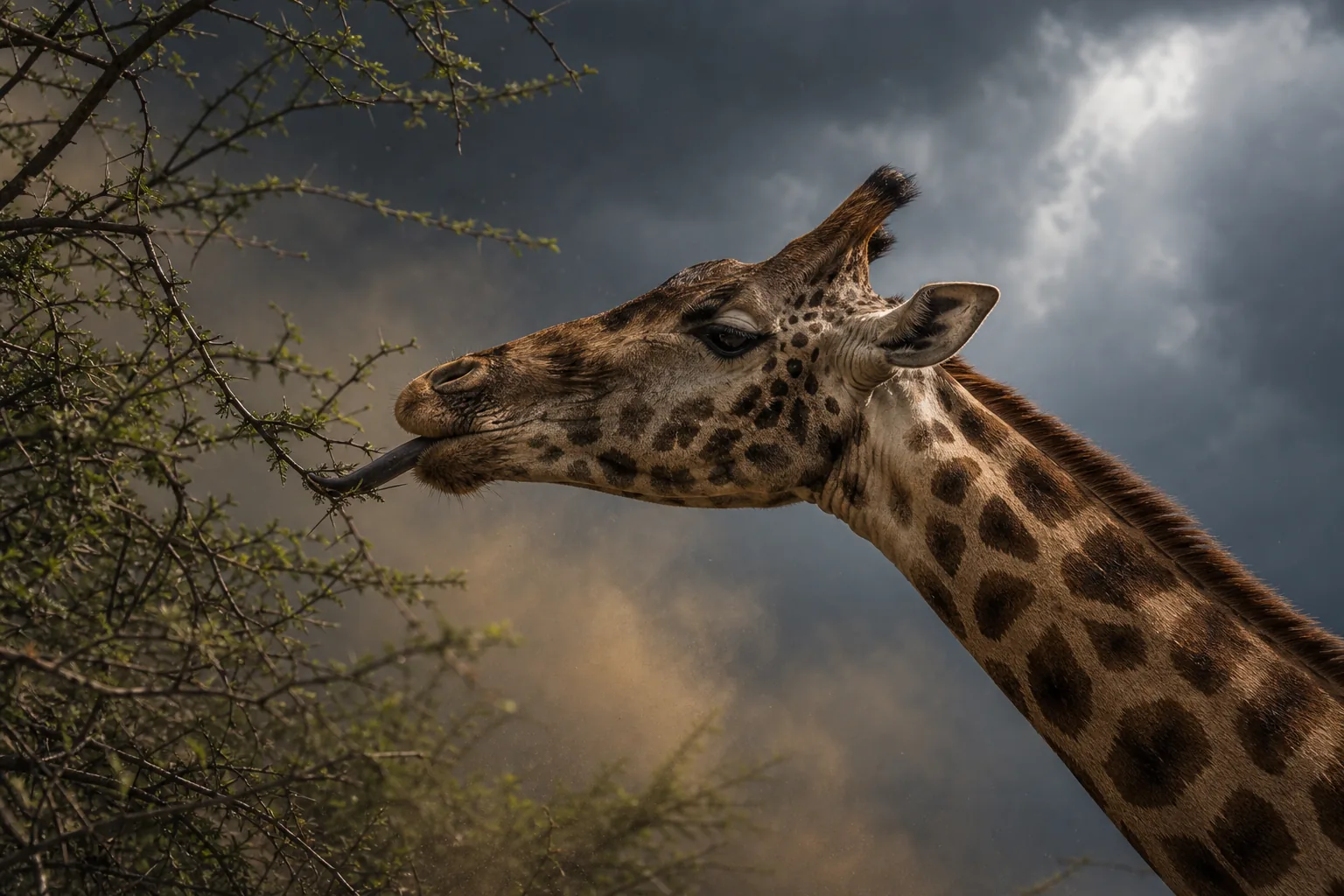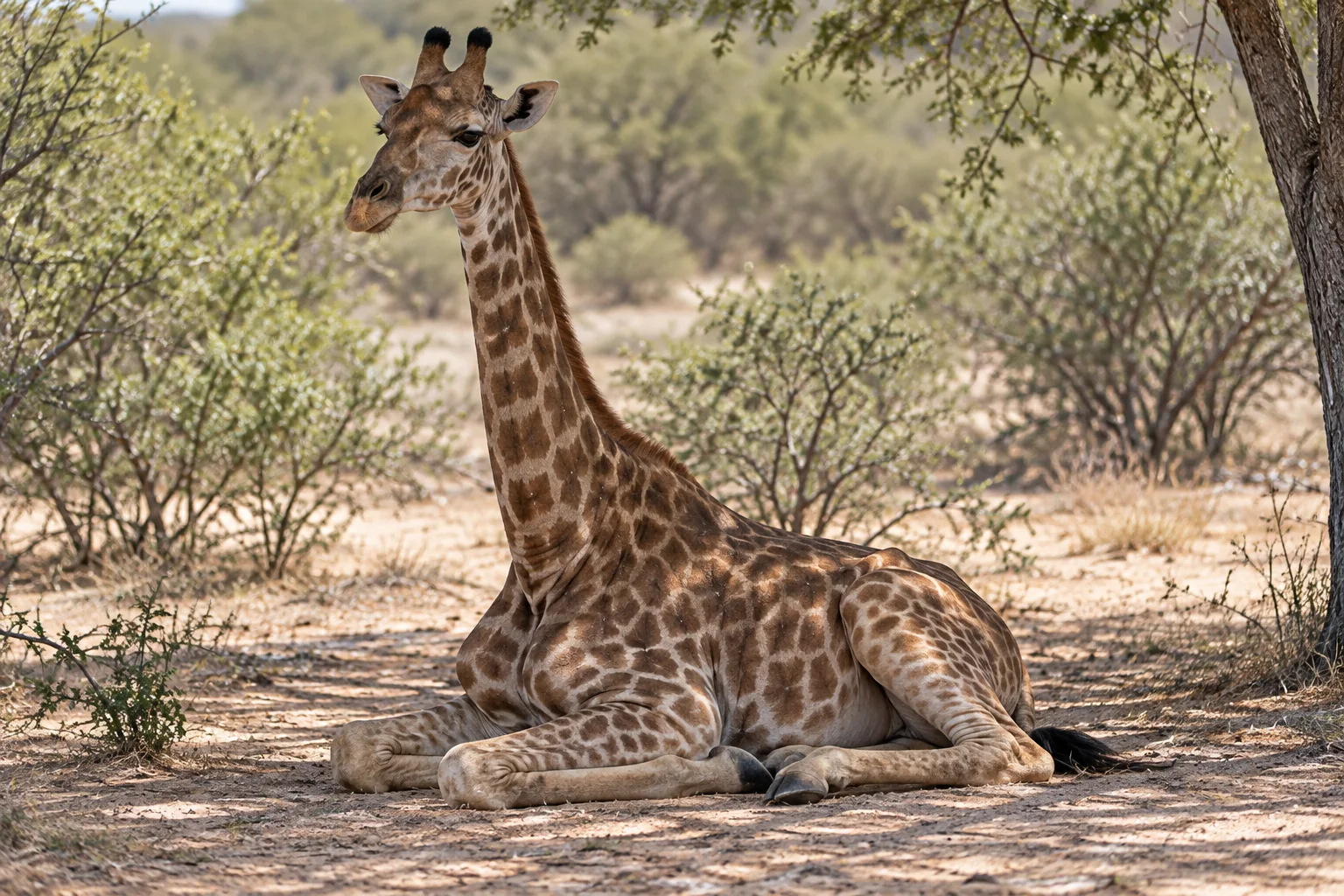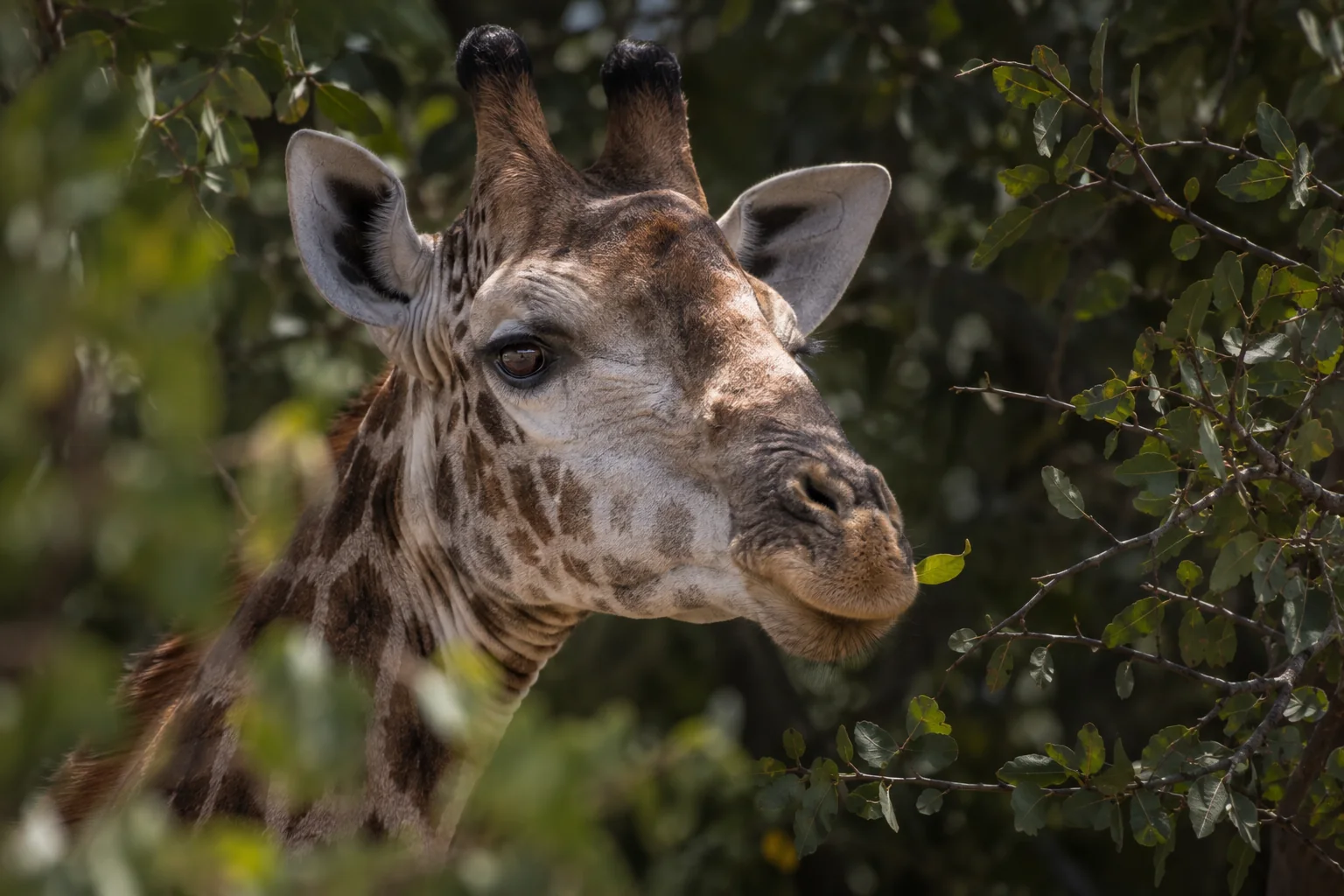
A bundle of branches is both food and something a giraffe has to work with. The animal can select leaves, pull at twigs and strip bark. Later, it may return to the same branches or chew cud from food already swallowed. Which part of that sequence should count when comparing the value of different browse?
Zoe Newnham and Paul Rose followed five female giraffes at Marwell Zoo to examine the sequence rather than just the first approach. Their study compared four familiar tree species and watched the animals again after the initial feeding period.
The researchers expected thorny hawthorn to require extra handling and prolong feeding. The results did not support that simple prediction. Hazel elicited the shortest browsing time, while willow, oak and hawthorn were not clearly separated from one another in the pairwise comparisons. Later behaviour added another reason to resist choosing a winner from one measurement.
An ordinary meal, observed twice
The study took place during spring and summer in 2021 and 2022, when fresh leafy browse was available. The five females ranged from ten to twenty-five years old. Their regular hay and pellet feeding continued, and the project worked around the zoo's usual provision of cut branches.
The four species were goat willow, common hawthorn, common hazel and English oak. Bundles were suspended from the enclosure's browse systems. The observer recorded the number of branches supplied and then followed one identified giraffe for an hour, measuring time spent browsing and counting bites and jaw movements.
After a thirty-minute pause, observation resumed for another hour. This second period recorded what the animal did after the initial browsing opportunity, including rumination, other feeding and further browsing. It also recorded whether the giraffe returned to the original branches. “After feeding” therefore did not mean that every leaf had been eaten or that the branches had been removed.
Each giraffe supplied three paired observation sessions for each tree species, making 120 observation hours in total. Equal repetitions by animal and tree helped the comparison, but time of day and season were less balanced. Some combinations could not be repeated across both years and seasons because the work depended on ordinary husbandry and staff availability.
Models considered tree species alongside individual identity and other recorded circumstances. This was still a small observational case study, not a randomized feeding trial that independently controlled every difference in branch quality, leaf mass or social context.
The thorn prediction did not win
Figure 2 gives the main browsing-time result a clear shape. Hazel has the lowest mean, separated statistically from each of the other three species. Willow has the highest plotted mean, but the tests do not establish that it prolonged browsing more than oak or hawthorn.
The individual records add texture. Willow often held an animal's attention for much of the first hour, sometimes for the entire observation. Hazel generally supported shorter periods. Yet the spread differed among giraffes and tree species, which matters when an animal manager is planning opportunities for a particular herd.
Hawthorn did not produce the expected extra handling advantage. Compared with willow, the giraffes took fewer bites and made fewer recorded chews when given hawthorn. The study did not find a clear tree-species effect on bite rate or the ratio of chews to bites. Those results do not reveal whether thorns, taste, leaf structure or some combination shaped the response.
Bark stripping supplied another distinction. It occurred during 23 of the 60 initial observation sessions. It was less likely with oak than willow in the fitted analysis. A branch can therefore sustain interaction through more than leaf removal, but a behavioural observation alone does not establish whether more bark consumption is desirable for health.
What the second hour added
During the later observation periods, rumination was the most common predominant behaviour. Giraffes bring previously swallowed food back to the mouth and chew it again; this processing can continue after the most visible encounter with a branch bundle is over.
The paper's diagram linking tree species to later behaviour shows oak especially associated with rumination and willow with both rumination and further foraging. Giraffes also returned to original branches of every species. Oak had the most recorded returns, though the return totals were descriptive rather than a demonstrated statistical ranking of preference.
The later-behaviour model compared categories of activity, using a combined abnormal-behaviour category as its reference. It should not be read as a precise causal estimate of extra minutes of rumination produced by oak. The more useful observation is that the initial meal and the later activity did not carry identical information about each browse species.
A limited set of branch weighings in 2021 reinforces that distinction. For the three species with repeated weighings, consumed mass did not differ clearly, despite the differences in observed browsing time. Oak had only one weighed bundle, so it could not support the same comparison. Bite counts, time spent eating and the mass eventually consumed are different measurements.
Food access also has a social dimension. In a separate study, Edita Horová, Karolína Brandlová and Markéta Gloneková used repeated yielding at food to identify dominance relationships among captive giraffes. That does not establish that hierarchy caused the Marwell results. It explains why measuring who can reach preferred branches would add useful evidence to a future browse comparison.
The branch study did not analyse nutrient composition or test long-term health outcomes, so it cannot prescribe a nutritionally superior single-tree diet. Its contribution is a way to evaluate an opportunity through time: what the giraffe does when branches arrive, how it processes the food and whether it returns. Those observations can guide the next comparison without reducing a complex meal to the speed of its first disappearance.
Sources
- Newnham, Zoe; and Rose, Paul (2025). “Quantifying the influence of cut tree branches on zoo giraffe behavior during and post browsing: A case study on five animals and four tree species.” Journal of Veterinary Behavior, 80, 10–19. Paper and open author deposit.
- Horová, Edita; Brandlová, Karolína; and Gloneková, Markéta (2015). “The first description of dominance hierarchy in captive giraffe: Not loose and egalitarian, but clear and linear.” PLOS ONE, 10(5), e0124570. Related social study.