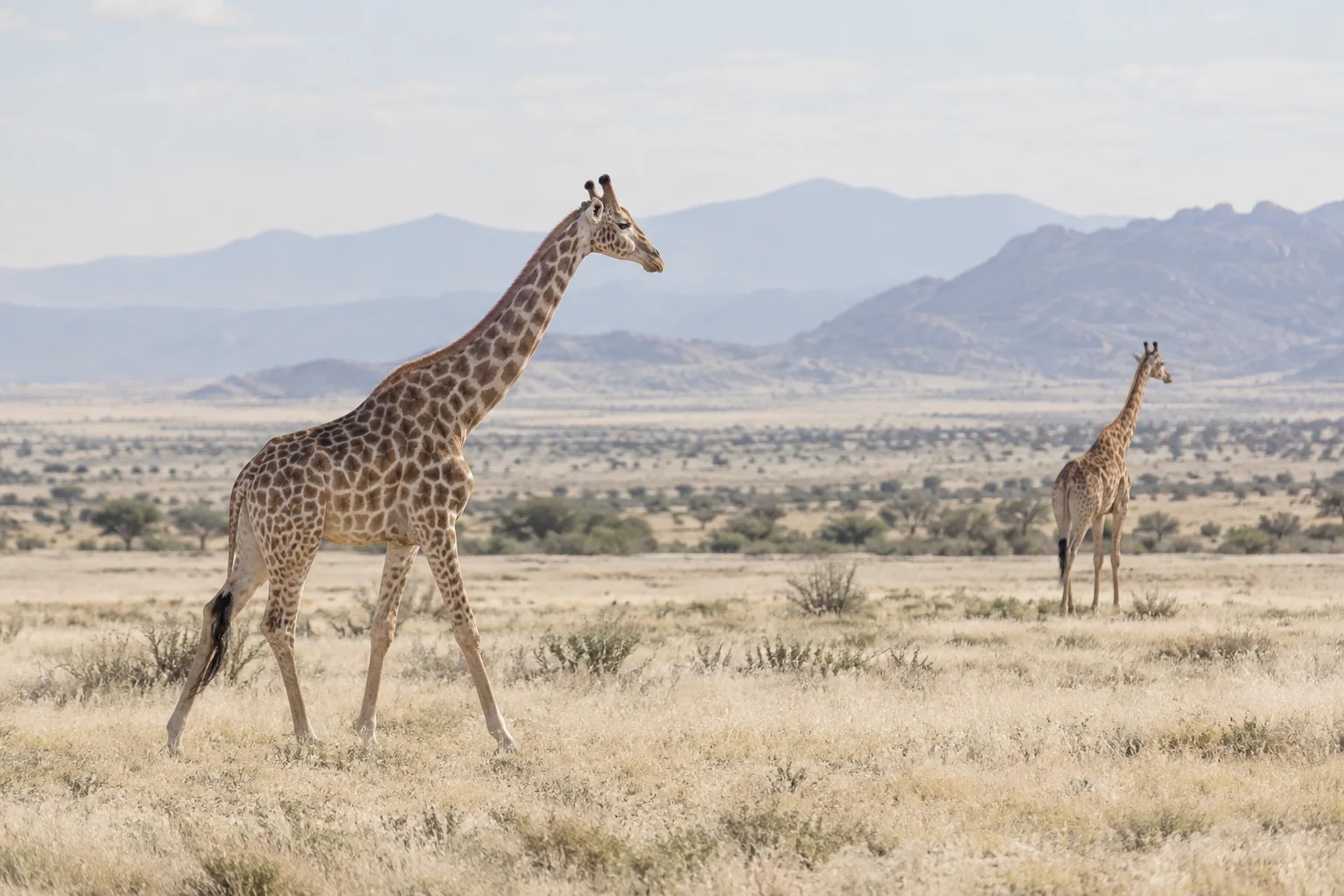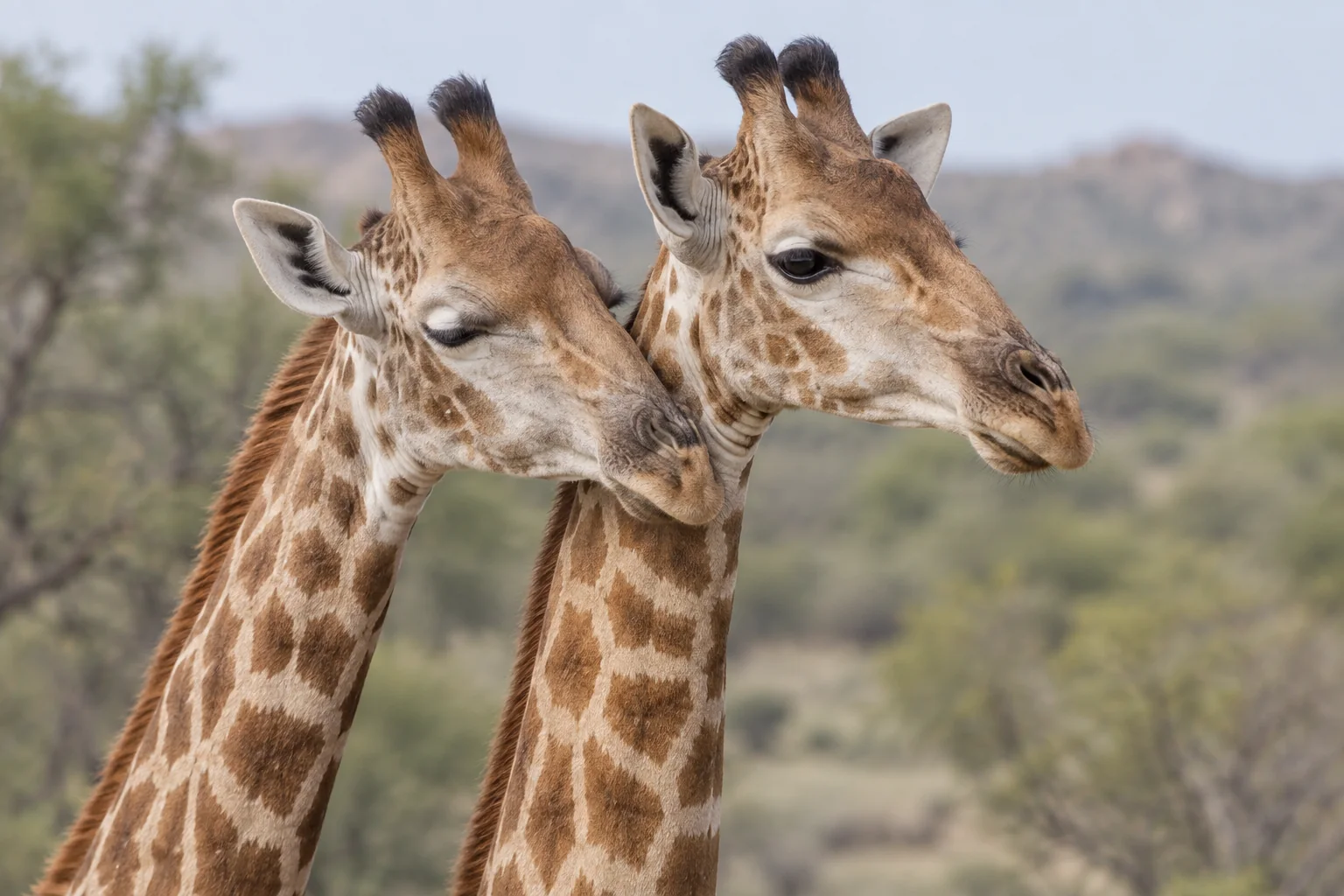
Two giraffes may repeatedly appear together because they choose one another’s company. They may also be neighbours using the same patch of habitat. Separating those possibilities is essential before describing a social bond. A second challenge follows: even when preferences are detectable, do relationships take the same form in different populations?
Zoe Muller, Innes Cuthill and Stephen Harris tackled both questions in a 2019 comparison of neighbouring Kenyan populations. They used the same observation and analysis methods at Soysambu Conservancy and Lake Nakuru National Park. Giraffes in both places showed preferred associations, but the populations differed in how strongly and extensively individuals were connected.
The distinction matters. The existence of social preferences can be shared between populations without every detail of their social organisation being the same. A description of giraffe society drawn from one site may capture a real pattern while missing important variation elsewhere.
Comparing like with like
The two study sites offered broadly similar climates and neighbouring landscapes, separated by a fence that prevented the giraffe populations from mixing. Their conditions nevertheless differed. During the study, Lake Nakuru had substantial tourist activity and a high lion density. Soysambu had less human activity and no resident lion population. The populations also differed in their age composition, with many more calves at Soysambu.
Keeping the observation method consistent helped ensure that any social contrast was not simply a difference in how researchers counted groups. The same observer identified giraffes from their coat patterns, recorded group membership and used a common definition based on proximity and broadly similar behaviour. Each group was observed for thirty minutes, and analysis used records for which the observer was confident that every member had been identified.
The observation periods lasted nine months at each site. They covered corresponding parts of the annual cycle, but different years: May 2010 to January 2011 at Soysambu, and May 2011 to January 2012 at Lake Nakuru. This was a comparison of populations under a shared method, not a simultaneous experiment in which only one condition changed.
Repeated sightings supplied an association index for each pair of giraffes. A value of zero meant they were never observed together; one meant they were always together when either was observed. Intermediate values described how regularly they appeared in the same group. The index measured observed association, rather than the frequency of physical contact or a direct assessment of affection.
Preferences survived a test of opportunity
To investigate preferences, the researchers compared each observed network with a thousand rearranged versions of its association records. The rearrangements respected the spatial and temporal structure of the observations, limiting swaps to animals recorded in the same area and period.
That restriction is biologically important. Randomly mixing every individual across an entire reserve would give animals opportunities to associate that they may never actually have had. A pair of neighbours could then appear unusually close merely because the comparison included many distant animals.
Both populations showed non-random associations under the study’s more constrained comparison. Particular companions occurred together more selectively than the rearranged records predicted. Social preferences were therefore detectable at both sites, including the one with more lions and human activity.
The strength of those observed associations differed. Among pairs with a recorded connection, the mean association index was about 0.125 at Soysambu and 0.088 at Lake Nakuru. These are indices summarising sightings, not direct percentages of the animals’ entire lives. Their useful meaning is comparative: connected pairs were recorded together more consistently at Soysambu.
The Soysambu network also had greater density and clustering. Density concerns how many potential connections are represented; clustering concerns how connections form linked sets around individuals. These descriptive comparisons broadened the picture beyond average pair strength. They did not establish a general numerical effect of tourism or lions.
Taking calves out of a calculation
Calves often accompany their mothers, making mother–calf pairs an obvious possible influence on a social network. If one population contains many more calves, it could appear more strongly connected partly because it contains more of these associations.
The team therefore repeated the analyses after excluding calves from the networks. The contrast between populations remained: the average association index was almost unchanged, and Soysambu still had higher density and clustering. Simply counting calf connections was not enough to explain the result.
Removing calves from an analysis does not remove their influence on adult behaviour. Mothers still make decisions in the presence of their young, and adults living in a population with many calves may behave differently from adults in one with few. The comparison narrows one explanation without resolving every demographic influence.
What would explain the difference?
Muller and colleagues considered lions and human activity as possible influences on social organisation. Both differed between sites, so the design could not isolate either one. Year-to-year conditions, habitat differences and the composition of the populations also remained possible contributors.
The study therefore makes a strong case for comparing populations, while providing a starting point for testing causes. It did not establish that the weaker network caused poor calf survival, or that losing calves caused the social difference. The authors explicitly raised that direction-of-causation question.
Following the same identified adults through births and calf losses could help reveal which changes precede others. Comparing more populations, including places where lion presence and human activity vary separately, could begin to distinguish those influences. Consistent observation methods would remain essential so that the comparison retained its biological meaning.
The central result is a useful combination of similarity and variation. Giraffes at both sites showed preferences in their changing groups, but those preferences formed different population-wide patterns. Understanding the species requires room for both.
Sources
- Zoe Muller, Innes C. Cuthill and Stephen Harris (2019). “Giraffe (Giraffa camelopardalis) social networks in areas of contrasting human activity and lion density.” Ethology 125(10), 702–715. DOI · Author-uploaded full paper.