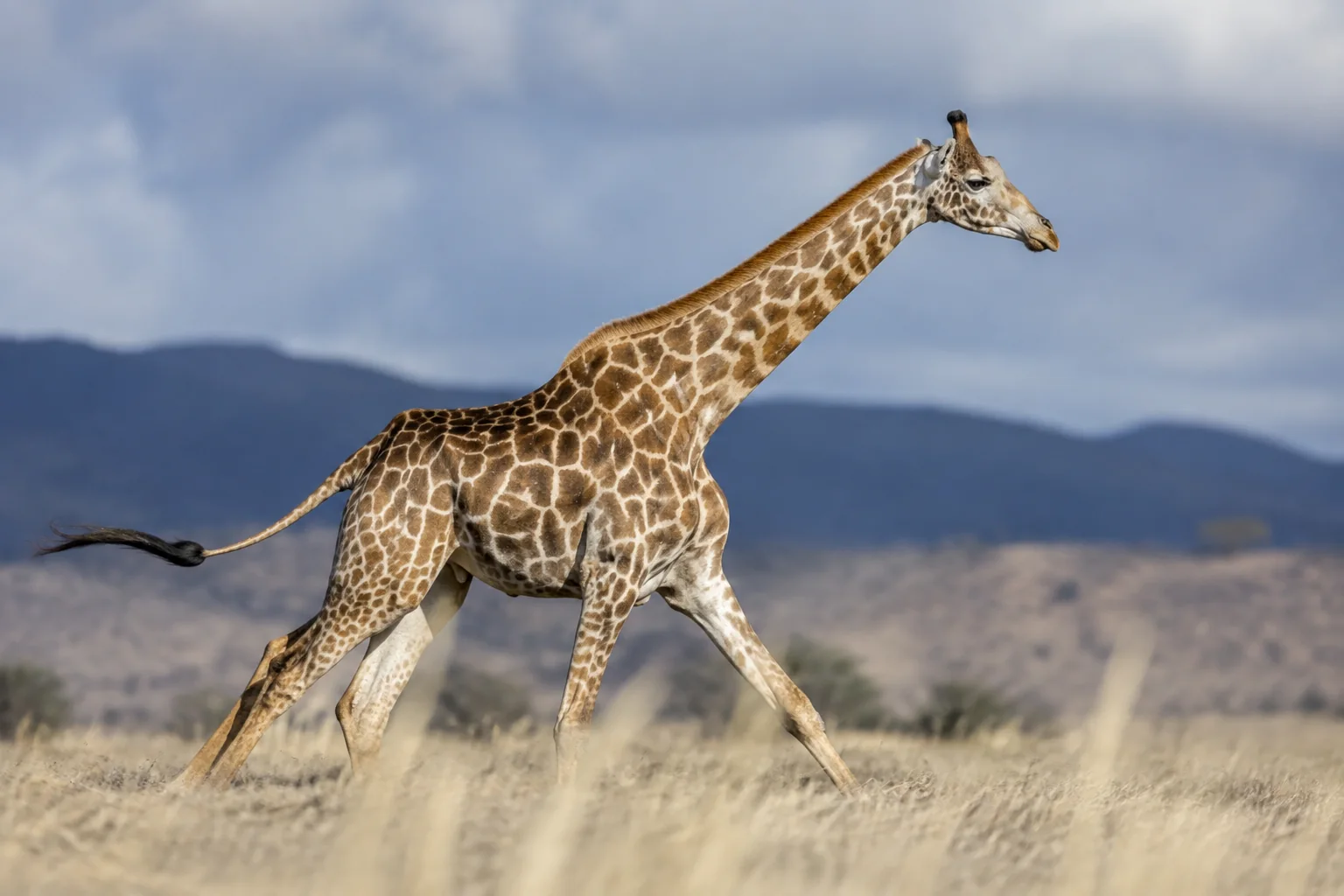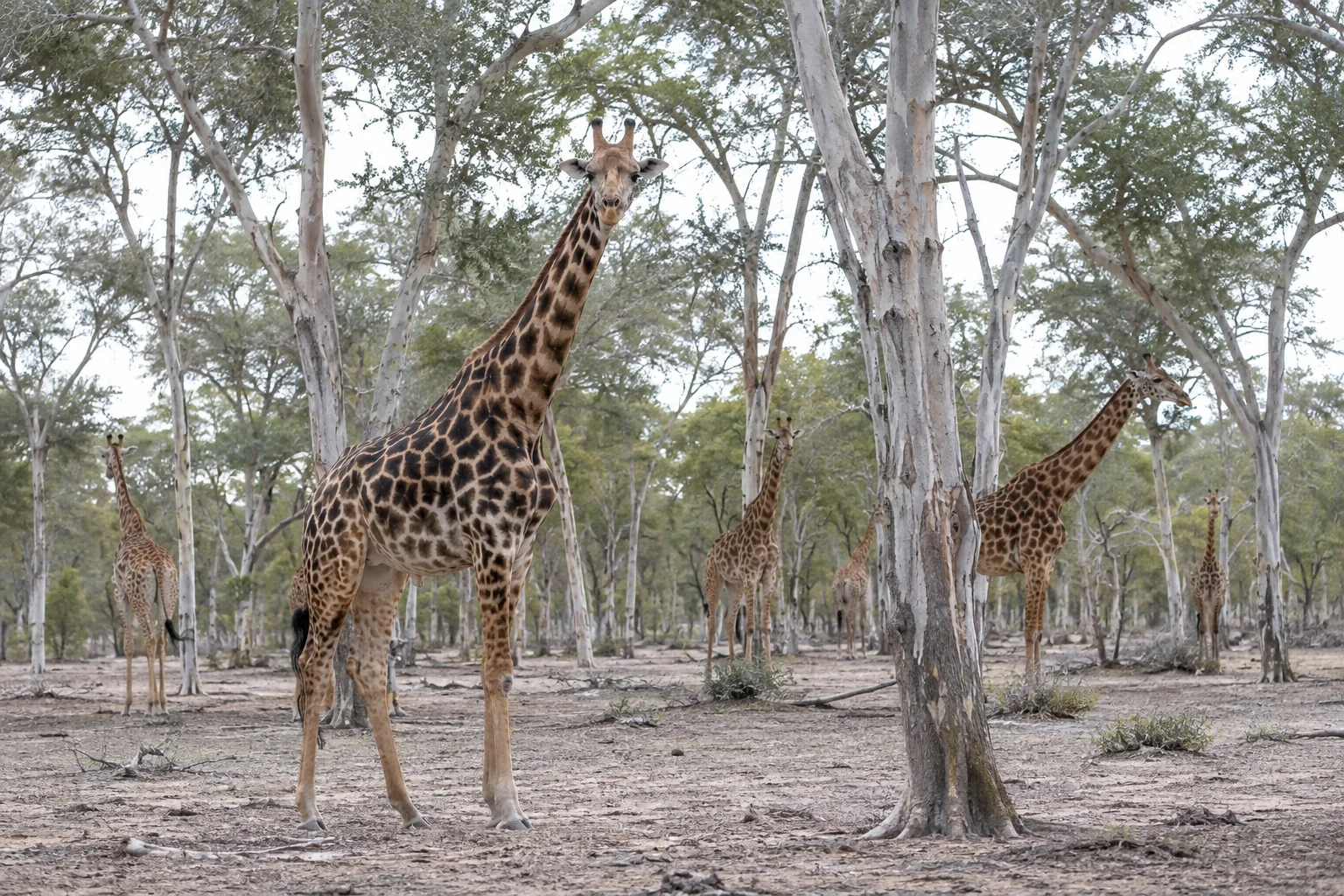
Two people can watch the same pair of giraffes and write down different things. One may record “necking”, another “sparring”, and a third “aggression”. Unless they explain what those words mean, combining their records can mix gentle contact with forceful blows.
That was the problem Peter A. Seeber, Isabelle Ciofolo and André Ganswindt addressed in their behavioural inventory of giraffes. Published in 2012, it assembled 65 descriptions from earlier research and the team’s own observations. The contribution was a common observational language: a way to turn a visible action into a record that another researcher could recognise.
The inventory also exposed a deeper difficulty. Describing a movement is easier than establishing its purpose. Even a carefully named posture can mislead if an observer overlooks the animals’ distance, the preceding encounter or the other giraffe’s response.
A catalogue tested against living animals
The researchers examined 104 publications, including scientific papers, books and theses. They then observed giraffes in three contrasting settings: Hwange National Park in Zimbabwe, Entabeni Game Reserve in South Africa, and the National Zoological Gardens in Pretoria.
The most extensive field component was at Hwange, where they spent 272 hours observing giraffes across visits in 2010 and 2011. Further observations at Entabeni and brief zoo observations allowed them to compare existing descriptions with animals in different circumstances.
This was not a survey designed to estimate how often every giraffe performs each behaviour. Observers sought examples that could confirm, refine or extend definitions. A rarely seen act could therefore be valuable even without a frequency estimate.
The resulting ethogram—a catalogue of defined behaviours—distinguished general activities from interactions involving other animals. Within those broad groups it described feeding and movement, repetitive behaviours, courtship, encounters between males, calf behaviour and maternal care.
The categories made the record manageable, but the authors recognised that the boundary between a solitary activity and an interaction could be uncertain. A giraffe may respond to another animal or a cue outside the observer’s immediate attention. Apparently independent behaviour can have an unseen social context.
Similar movements, different encounters
The descriptions of neck contact show why precision helps. Rubbing involves contact of the head or neck against another giraffe. Sparring includes head swings and comparatively soft blows. Serious fighting involves much faster and more powerful strikes.
Those distinctions allow an observer to ask whether an animal has begun fighting more often, rather than reporting a vague increase in “necking”. They also make it easier to compare changes over time without silently changing the definition halfway through a study.
The inventory did not assume that all familiar behaviours belonged exclusively to one sex or age group. The researchers reported some actions in animals outside the categories assigned to them in earlier literature. Such observations helped widen the descriptions rather than force every new encounter into an old rule.
Attempts were also retained as behaviours in their own right. A calf approaching an udder and being prevented from nursing is a different event from successful suckling. Counting only completed nursing would erase information about access, rejection and interaction between mother and calf.
That distinction now helps explain studies asking why more experienced mothers permit more nursing. The biological question depends on recording the unsuccessful approaches as well as the visible bouts.
A high head did not carry one fixed message
Earlier descriptions disagreed over the posture of a dominant male. Some described a high-held head, making the animal appear large. Others described a lowered neck closer to a fighting position.
Rather than treating one description as necessarily wrong, Seeber and colleagues suggested that distance could matter. A display across a wider gap may differ from a threat delivered beside an opponent. Their observations were consistent with that possibility, but did not experimentally establish a distance-based signalling rule.
Submission presented a similar problem: posture alone could be ambiguous. The other animal’s behaviour, and whether the encounter ended in yielding or escalation, supplied essential context.
This is why a shared vocabulary does not operate like a dictionary translating every movement directly into an intention. It gives observers a clearer description of the action. The interpretation still requires evidence from the encounter.
A foundation that can be revised
The inventory’s usefulness is visible in later work. A case report on aggression between two zoo bulls adapted its definitions to record rubbing, lining up and sparring during a management intervention. That allowed observers to track specified actions while keepers assessed the animals’ broader welfare.
An ethogram also needs updating. For example, early statements about females allowing only their own calves to nurse do not encompass the subsequently documented variety of nursing relationships. Retaining an observable definition while revising assumptions about its purpose is part of how a catalogue improves.
One useful next question is how reliably different observers assign the same behaviour to the same video. A second is whether descriptions remain adequate across settings, ages and group types. Disagreements would identify definitions needing refinement, rather than automatically indicate that the animals behave differently.
The lasting achievement is therefore practical: before asking why giraffes act as they do, researchers gained a clearer way to agree on what happened.
Sources
- Peter A. Seeber, Isabelle Ciofolo and André Ganswindt (2012). Behavioural inventory of the giraffe (Giraffa camelopardalis). BMC Research Notes 5, 650. DOI: 10.1186/1756-0500-5-650. Open full text and behavioural tables.
- Jessica J. Harley, Roann Tracey, Christina R. Stanley and Lindsay Banks (2024). Management of intraspecific aggression in two bull giraffes (Giraffa camelopardalis ssp. rothschildi). Zoo Biology 43(4), 383–390. Open paper.