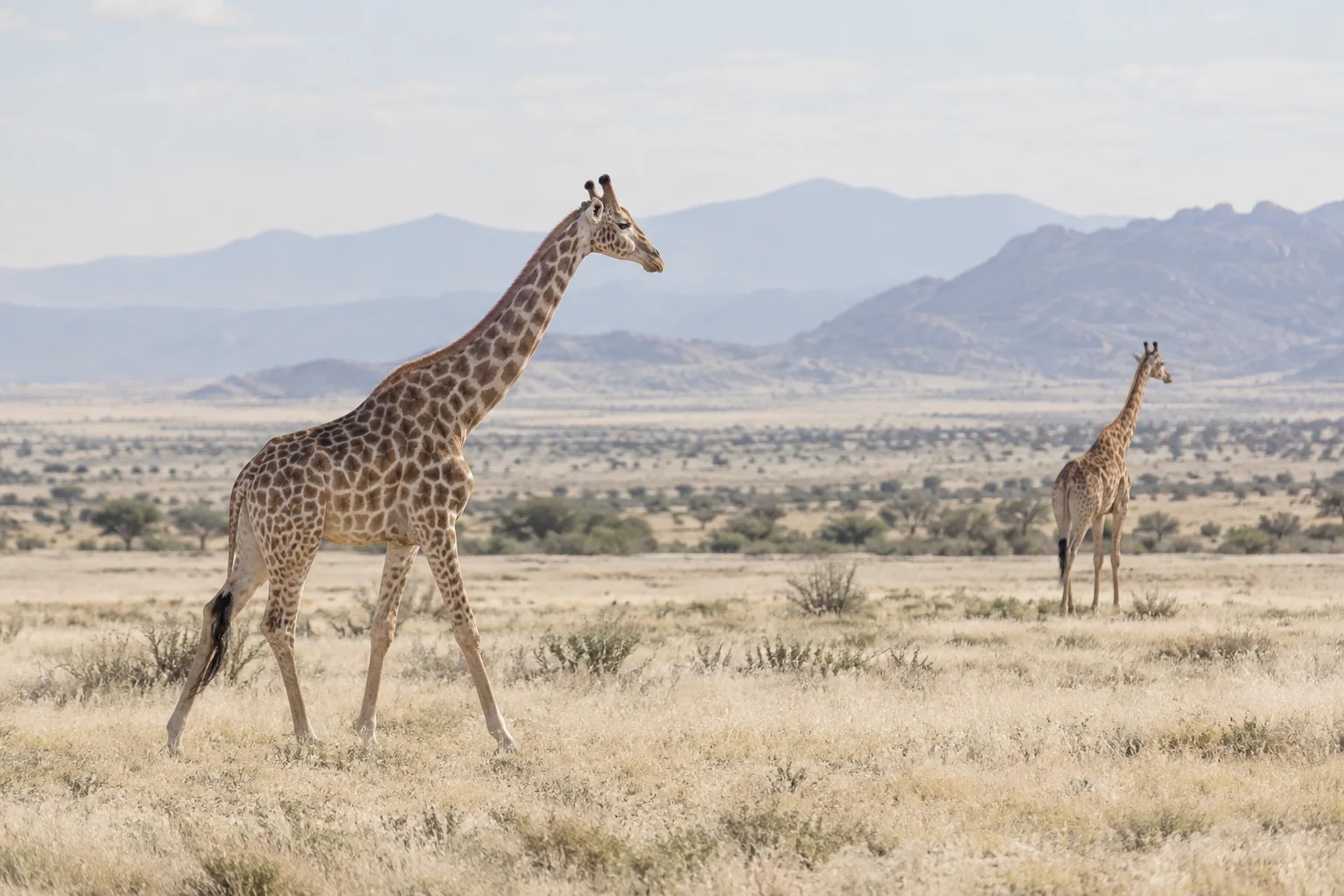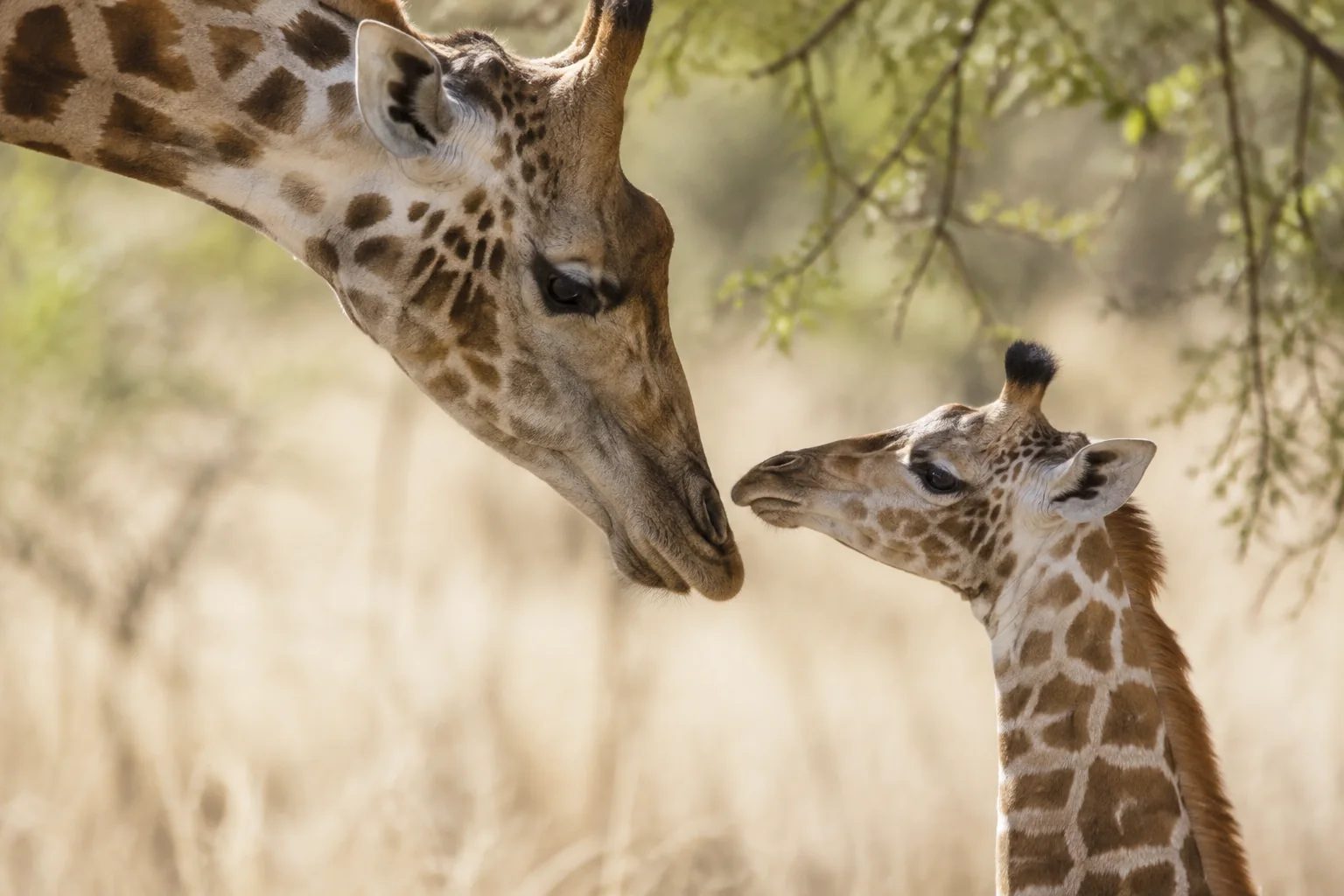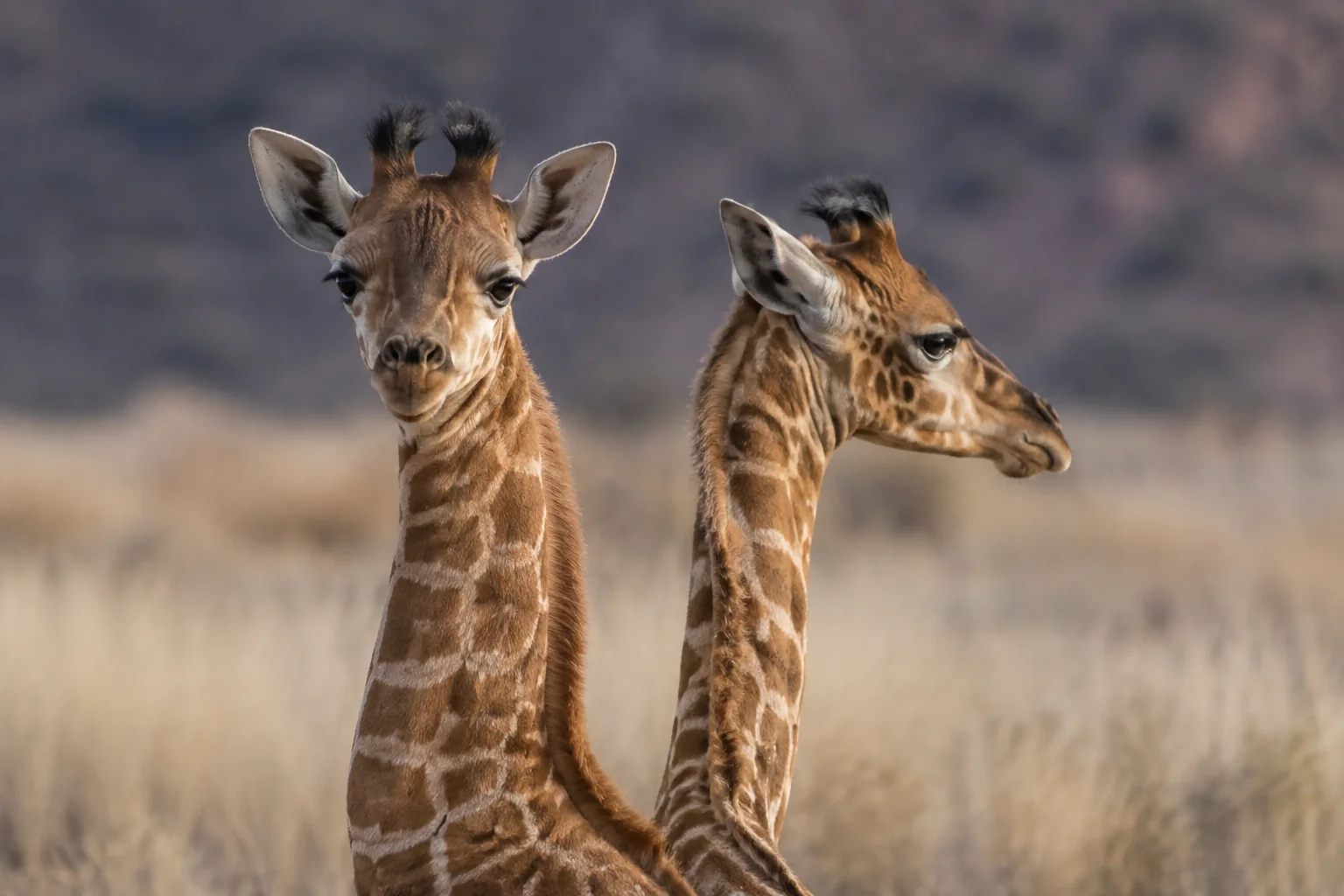
A young giraffe can encounter many other giraffes without spending equally much time with all of them. That difference matters when asking how an animal grows into its adult social life. Is adolescence mainly a period of meeting more companions, or one of repeatedly associating with particular kinds of companions?
Zoe Muller, Innes Cuthill and Stephen Harris investigated that distinction in two Kenyan giraffe populations. Their strongest shared result concerned repeated company: adolescent females associated most strongly with other adolescent females, and adolescent males with other adolescent males. The animals were not simply accumulating an unusually large number of different contacts. The study, published in Mammalian Biology in 2022, places peer relationships at the centre of a question about giraffe development.
Adolescence as a social stage
The researchers defined adolescents as giraffes between roughly one and four years old. They separated these animals from younger calves, adult females, adult males and a further category of mature males identified from age-related physical features.
These were field age classes, not known birthdays for every individual. The categories allowed the team to ask whether animals at a comparable stage associated differently from adults, while acknowledging the difficulty of ageing a wild giraffe precisely.
The two study populations lived in neighbouring but enclosed areas of Kenya’s Rift Valley. Researchers surveyed one for nine months in 2010–2011 and the other for nine months in 2011–2012. The same observer collected the data using the same approach at both sites, making the comparison more consistent than combining unrelated surveys.
Individuals were recognised from photographs of their coat patterns. On each encounter, the team recorded which animals were in the same group, defined by proximity and broadly similar activity. Repeated sightings then became a network in which each giraffe was connected to the companions with whom it had been observed.
Young calves were excluded from the analysis, partly because very few occurred in one population and partly because mother–calf association would answer a different question. The analysed networks contained 84 giraffes at one site and 51 at the other, including four and ten adolescent females, respectively. Those small female-adolescent samples are an important limit on how broadly the results can be applied.
Many acquaintances or repeated partners?
The network analysis measured two different aspects of social life. One was the number of distinct associates: how many other giraffes an adolescent had been observed with at least once. The other was association strength: how often a particular pair appeared together relative to their opportunities to be observed.
An animal can score highly on one measure without scoring highly on the other. A giraffe moving through many groups may meet a large fraction of the population but spend relatively little time with each individual. Another may encounter fewer companions and repeatedly return to the same ones.
The researchers compared the observed networks with randomized versions of the data, restricting exchanges by location and sampling period. This helped test whether the association pattern exceeded what could arise from the animals’ availability in the same places and times.
The expectation that adolescents would simply seek unusually many associates was not supported. Female adolescents did not have more distinct associates than expected by chance. Several comparisons indicated that male adolescents had fewer. The evidence for selective repeated company was clearer than the evidence for a general expansion of the contact list.
The common pattern—and the differences between sites
At both sites, the strongest associations for each adolescent sex were with adolescents of that same sex. At Lake Nakuru, for example, the average association index among adolescent females was 0.37, compared with 0.23 in the randomized networks. Male adolescent pairs averaged 0.18, compared with 0.12 in the randomized comparison. These values describe repeated co-occurrence within this sampling scheme; they are not percentages of the entire day spent together.
Adult partners added variation. Adolescent males had stronger-than-expected associations with adult males in both populations. Female adolescents showed stronger-than-expected associations with adult females at Lake Nakuru, but that result did not hold at the second site. At the second site, male and female adolescents also associated with one another more strongly than expected.
Those details qualify the appealing headline that all adolescents first choose same-sex peers and then same-sex adults. The same-sex peer result was consistent; the wider set of adult and opposite-sex connections depended on the population. A social system can contain both a recurring developmental pattern and local differences.
Company creates opportunities; it does not prove teaching
Repeated peer association could give young giraffes opportunities to practise social behaviour. Associations with adults might provide access to experience of resources, routes or other animals. The authors discuss these possibilities, including the potential role of male groups in practising necking behaviour.
The network study did not measure knowledge before and after an encounter, track the transfer of a behaviour, or demonstrate that one giraffe taught another. Similar needs could also draw adolescents together: animals of comparable size and life stage may favour similar activities without learning from each other. “Young giraffes form peer associations” is therefore a finding; “those associations function as a school” is a hypothesis.
A longer study in Tanzania followed young giraffes over at least five years and found that males dispersed from their original setting more often than females. Some changed social community without moving far. That work concerns eventual community membership, whereas the Kenyan analysis describes the structure of associations during a shorter developmental window. The two studies cannot show that a particular adolescent bond caused a later dispersal decision.
Social provision needs more than a head count
For giraffes under human care, the study raises a useful husbandry question: does a young animal have access to compatible peers and adults, as well as enough companions in total? The wild observations justify asking that question. They do not establish an ideal zoo group composition or prove that placing two adolescents together will improve welfare.
The same restraint makes the developmental result more useful. Adolescence was not socially featureless, and its pattern could not be captured simply by counting how many giraffes shared an enclosure or landscape. The important distinction was between the possibility of meeting and the tendency to associate repeatedly. Understanding that distinction is a step toward understanding how young giraffes build an adult social life.
Sources
- Zoe Muller, Innes C. Cuthill and Stephen Harris (2022). “Adolescence and the development of social behaviour in giraffes.” Mammalian Biology 102, 1333–1343. Full paper.
- Monica L. Bond, Derek E. Lee, Arpat Ozgul, Damien R. Farine and Barbara König (2021). “Leaving by staying: Social dispersal in giraffes.” Journal of Animal Ecology 90, 2755–2766. Related study.