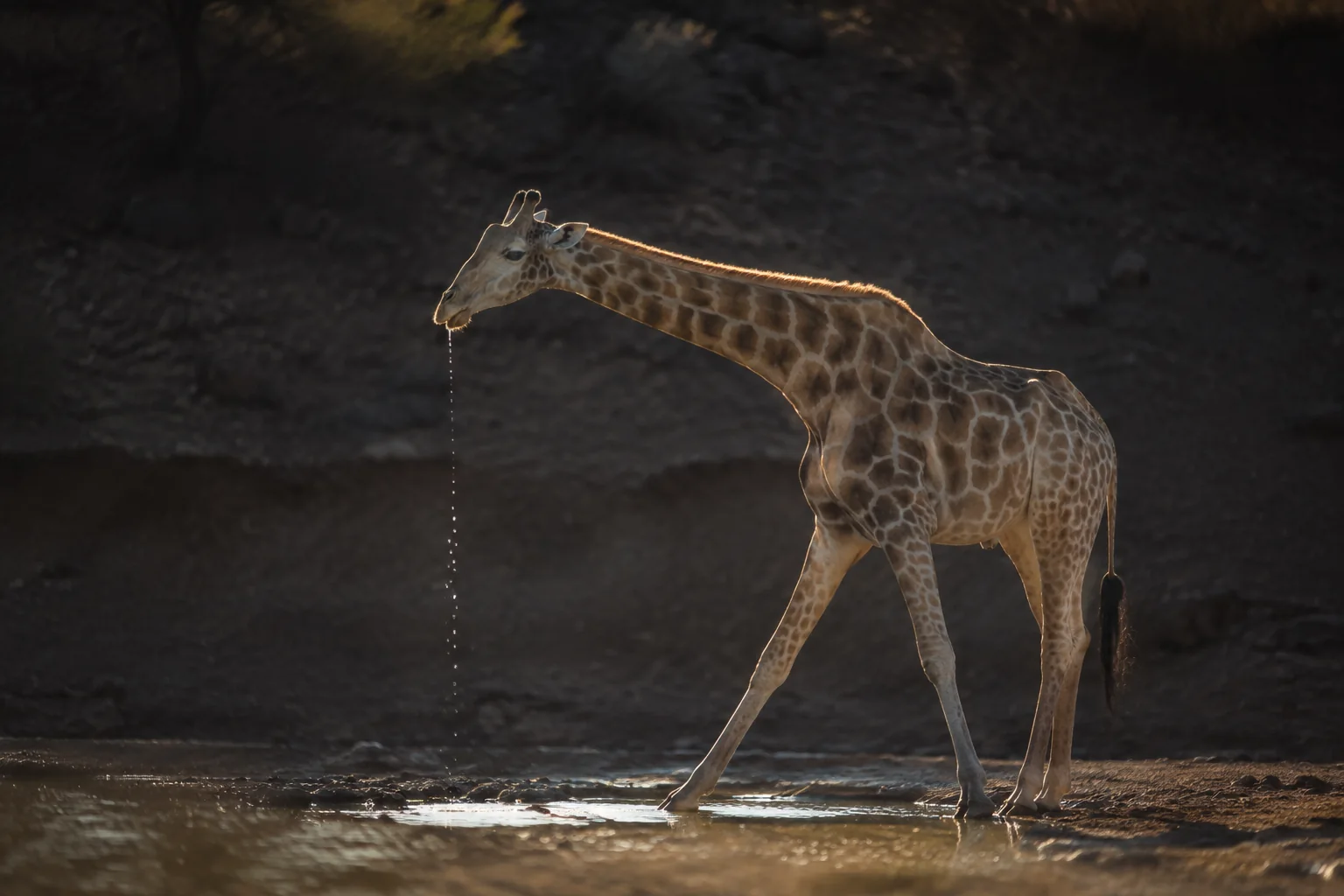
A giraffe spreads its legs, lowers its head and drinks. The large movements are easy to see. In a small patch near the back of a hind leg, a much subtler rhythm can be hidden in the changing colours recorded by the camera.
Henrik Lauridsen and colleagues extracted that rhythm in a 2019 study in BMC Biology. The giraffe footage was already online and had not been recorded for a physiology experiment. Its inclusion in a broader study of video magnification asked a useful question: how much information might an animal video contain beyond the behaviour that first catches our attention?
Magnifying a change, rather than zooming in
Enlarging an image makes a giraffe’s leg bigger on the screen. Eulerian video magnification does something different: it strengthens small changes across successive frames.
For colour magnification, the software follows variations in pixel values over time, selects a range of repeating frequencies and amplifies those variations. Blood arriving in superficial tissues can change their appearance slightly as the pulse passes. Amplifying a repeating colour fluctuation may therefore reveal a heartbeat-related signal that was difficult to notice in the original footage.
The processing is selective. A very slow change in illumination and a much faster repetitive change need not receive the same amplification. Researchers can first examine a broader frequency range, then narrow it around a candidate rhythm. The important question is whether the selected rhythm belongs to the animal’s physiology: filtering makes a pattern more conspicuous, but does not establish its biological cause.
For the giraffe, the team examined the back of a hind limb near the posterior tibial artery. This location offered relatively thin fur and a vessel running close to the surface. They also plotted a background region from the scene, helping distinguish a local fluctuation from changes affecting the wider image.
The source was an ordinary high-definition recording, 1280 by 720 pixels at 30 frames per second. Specialised imaging equipment had not been attached to the giraffe.
What five cycles can reveal
With the head lowered, the amplified signal showed five cycles. Their average timing gave an estimated heart rate of about 42 beats per minute. After the animal lifted its head, only one cycle was available, corresponding to about 45 beats per minute.
Those numbers illustrate why the length of a usable recording matters. A rate expressed “per minute” need not come from watching a full minute. It can be calculated from the interval between successive pulses: a cycle lasting roughly 1.4 seconds corresponds to about 43 per minute. But converting a short interval into that familiar unit does not create additional observations.
The giraffe result therefore cannot establish that lifting the head increased its heart rate, or that the rate stayed unchanged. One cycle in the second posture offers too little evidence to distinguish a consistent response from ordinary variation or measurement error. The paper’s meaningful result is the recovered rhythm itself.
How the researchers checked the method
The strongest verification in the study came from experiments in other animals. In an anaesthetised axolotl, a salamander with useful visible superficial tissues, the researchers recorded video while obtaining an ultrasound heartbeat signal. The timing matched the amplified optical changes. Further axolotl experiments compared video estimates with ultrasound under resting and anaesthetised conditions.
That supplies evidence that the technique can recover a real physiological signal in suitable conditions. It does not automatically validate every processed video. The online giraffe recording had no simultaneous ultrasound or other independent heart recording. Its estimated rate was plausible in relation to earlier giraffe measurements, but plausibility is a weaker check than recording the same heartbeat by two methods.
This distinction matters because a camera captures light, not a diagnosis. Shadows, reflections, camera movement and movement of the animal can all generate changing pixel values. Thick fur can conceal the relevant surface altogether. A repeatable pattern becomes convincing physiological evidence when its location, timing and independent checks support that interpretation.
A different use for wildlife footage
Obtaining measurements without touching an animal could help researchers observe physiology during ordinary behaviour. It could also make an existing recording useful for a question its creator never intended to study. Both possibilities are valuable precisely because attaching equipment or handling an animal can change the state a researcher hopes to measure.
Yet heart rate is only one part of circulation. A pulse rhythm alone does not reveal blood pressure, the volume pumped in each beat, or how blood reaches the brain when the head moves. Those questions require other measurements, such as the pressure and flow recordings used in giraffe drinking experiments.
The 2019 demonstration gives a concrete reason to look more carefully at video: an apparently uneventful patch of skin may contain a measurable rhythm. Turning that possibility into a dependable tool for giraffes requires checking the rhythm against an independent measurement under the conditions in which it will be used.
Sources
Lauridsen, H., Gonzales, S., Hedwig, D., Perrin, K. L., Williams, C. J. A., Wrege, P. H., Bertelsen, M. F., Pedersen, M., and Butcher, J. T. (2019). Extracting physiological information in experimental biology via Eulerian video magnification. BMC Biology, 17, 103. DOI and full paper: 10.1186/s12915-019-0716-7. Figure7 presents the giraffe signal; Figures1–2 show the axolotl verification and Table1 gives recording settings.