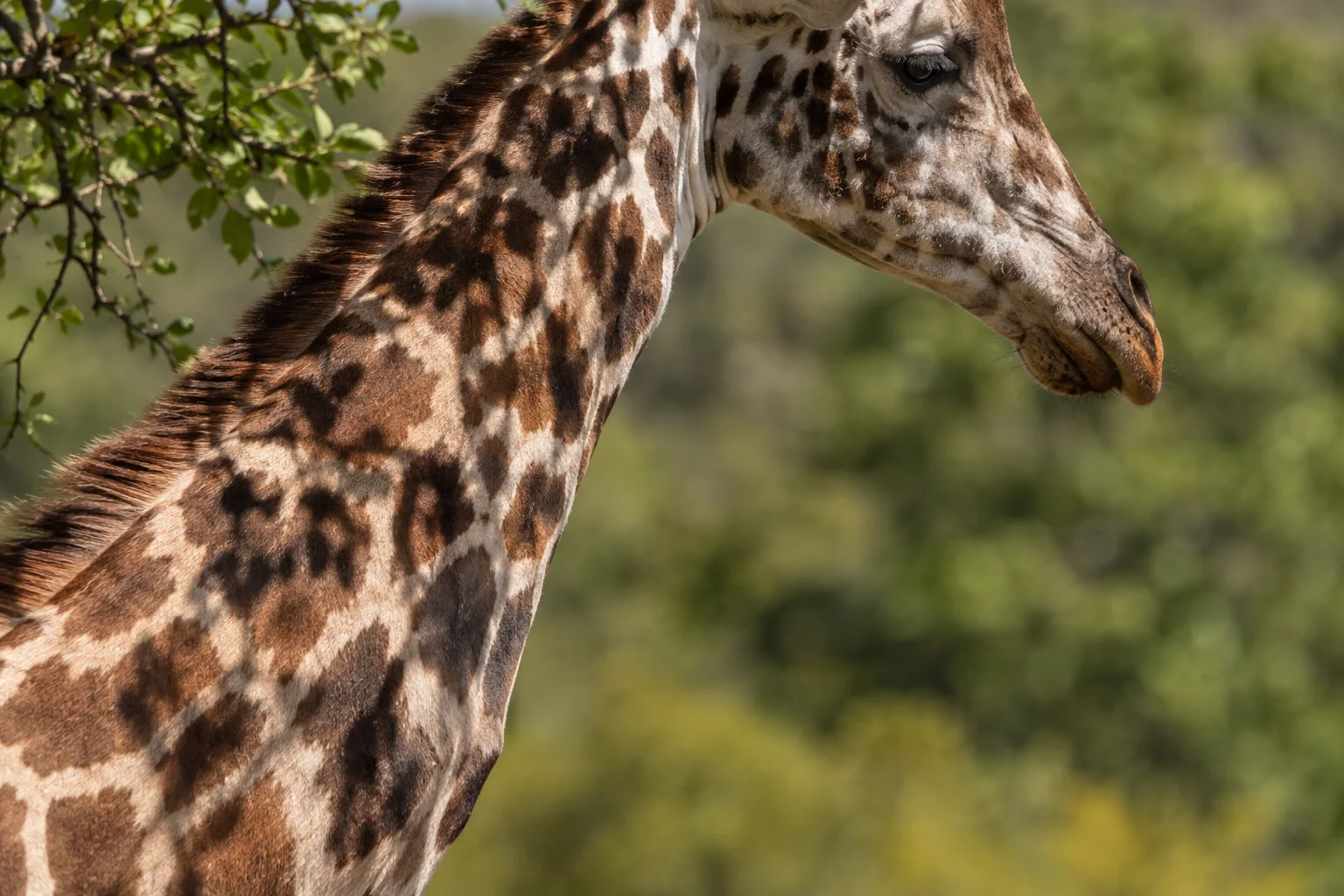
A giraffe’s height creates a linked biological problem. Its skeleton must grow exceptionally long, while its circulation must deliver blood to a brain well above the heart. Evolution has had to accommodate both. Finding a DNA difference associated with either system is intriguing, but an association alone does not establish what the difference actually does.
Chang Liu, Jianbo Gao, Xinxin Cui and their colleagues crossed that gap in a 2021 Science Advances study. They identified a distinctive cluster of changes in a giraffe gene and introduced those changes into mice. The resulting animals provided a way to test a candidate mechanism inside a living body.
Choosing a candidate from a better genome
The team began by assembling a giraffe genome with much longer continuous stretches than earlier versions, then comparing it with a broad collection of other mammal genomes. Better sequence continuity helps researchers avoid mistaking a missing or badly assembled stretch for a biological difference.
One candidate was already especially interesting: FGFRL1, which encodes a protein associated with growth-factor signalling. Growth factors are signals that influence how cells develop and behave. Changes in the proteins that interact with them can therefore affect more than one tissue.
The giraffe version had seven distinctive amino-acid substitutions clustered in a region involved in binding those signals. Amino acids are the building units of proteins; altering them can change how a protein interacts with its partners. The expanded comparison supported the conclusion that these seven changes were characteristic of giraffes.
The researchers used gene editing to place them into the corresponding mouse gene. This produced mice carrying a giraffe-like version of that small protein region, while the rest of their biology remained that of mice. The animals survived and reproduced, making physiological comparisons possible.
A pressure challenge revealed an effect
The cardiovascular experiment compared edited and ordinary mice, each with and without a treatment designed to raise blood pressure. That treatment delivered angiotensin II for 28 days. Angiotensin II can increase pressure through effects including narrowing blood vessels and retaining sodium.
At baseline, the two genetic groups did not differ significantly in blood pressure. The difference appeared under the challenge. Ordinary treated mice reached an average systolic pressure of about 159 millimetres of mercury; edited treated mice averaged about 125. Systolic pressure is the higher pressure produced when the heart contracts. The edited animals’ pressure after treatment was not significantly different from that of their untreated genetic counterparts.
The team also examined the heart and kidneys. Treated edited mice had less abnormal collagen accumulation, or fibrosis, than treated ordinary mice, and measurements of heart pumping function were better preserved.
The causal result is specific: introducing these changes altered the mice’s response to this experimental challenge. Because the edited mice largely avoided the pressure rise, their reduced tissue damage cannot by itself show that the gene protects organs while they endure equally high pressure. That distinction matters when relating the experiment to a giraffe, whose normal circulation already operates at high pressure.
Bone changed without becoming longer
The same gene changes affected skeletal development. Newborn edited mice had smaller skeletal elements and delayed development compared with ordinary newborns. By adulthood, however, the edited animals did not show a significant difference in body size, limb length or vertebral height.
A closer look inside the bones revealed something that overall length could not. Fine-resolution scans showed higher bone mineral density, a greater proportion of bone within the sampled volume and thicker internal struts in selected bones of edited adults.
Those internal struts help support the bone. Changing their structure can affect the skeleton without visibly elongating a limb. The experiment therefore gave stronger support to a role in bone development and structure than to a simple claim that this gene makes a long neck.
It also illustrated pleiotropy: a change in one gene can influence several traits. That is especially relevant when an animal’s body plan creates simultaneous demands on the skeleton and circulation. Yet the experiment took place in a mouse genetic background. Other giraffe genes and developmental interactions could modify the effect in giraffes themselves.
From an evolutionary clue to a mechanism worth testing
The wider genome comparison identified additional candidate changes connected with blood vessels, the heart and kidneys. Those remained candidates; they did not all receive the direct experimental test given to FGFRL1.
Anatomical research supplies a complementary level of explanation. Robert Stephenson and colleagues’ 2026 imaging study found a branching arrangement of heart-muscle aggregates in samples from giraffe and five other mammals. That study describes how muscle is organised; it does not establish which genetic changes generate the arrangement. Moving between genes, tissues and whole-animal circulation requires evidence at each level, as our heart and blood-pressure guide explains.
Liu and colleagues suggested that FGFRL1 might eventually inform research on hypertension. The useful next question is how the altered protein changes signalling during the pressure challenge. Their molecular simulations offered one possible explanation involving growth-factor binding, but a detailed physiological pathway still needed testing.
Further experiments could also separate resistance to developing high pressure from resistance to damage once pressure is high. That would bring the mouse result closer to the central giraffe puzzle. The achievement here is already substantial and precise: a cluster of evolutionary DNA differences was moved beyond prediction, and shown to change a living mammal’s physiology.
Sources
Chang Liu, Jianbo Gao, Xinxin Cui, Zhipeng Li, Lei Chen, Yuan Yuan, Yaolei Zhang, Liangwei Mei, Lan Zhao, Dan Cai, Mingliang Hu, Botong Zhou, Zihe Li, Tao Qin, Huazhe Si, Guangyu Li, Zeshan Lin, Yicheng Xu, Chenglong Zhu, Yuan Yin, Chenzhou Zhang, Wenjie Xu, Qingjie Li, Kun Wang, M Thomas P Gilbert, Rasmus Heller, Wen Wang, Jinghui Huang, Qiang Qiu (2021). A towering genome: Experimentally validated adaptations to high blood pressure and extreme stature in the giraffe. Science Advances. DOI: 10.1126/sciadv.abe9459. Read the full paper.